Documentation connects an adult day center's daily work to participant care, operations, billing, and regulatory review. It helps establish who received services, what happened during the day, which care plan or authorization applied, and what records are available later if a payer, regulator, auditor, or family asks a question. The challenge is that adult day care documentation requirements are not identical across the United States. State licensing rules vary, Medicaid programs can add separate requirements, managed care plans may require specific claim-supporting records, and programs such as CACFP can create another documentation layer. This guide provides a practical framework for organizing the records adult day centers commonly need while showing where requirements should be verified for your specific state, payer, and program.
Adult Day Care Documentation Requirements: Quick Answer
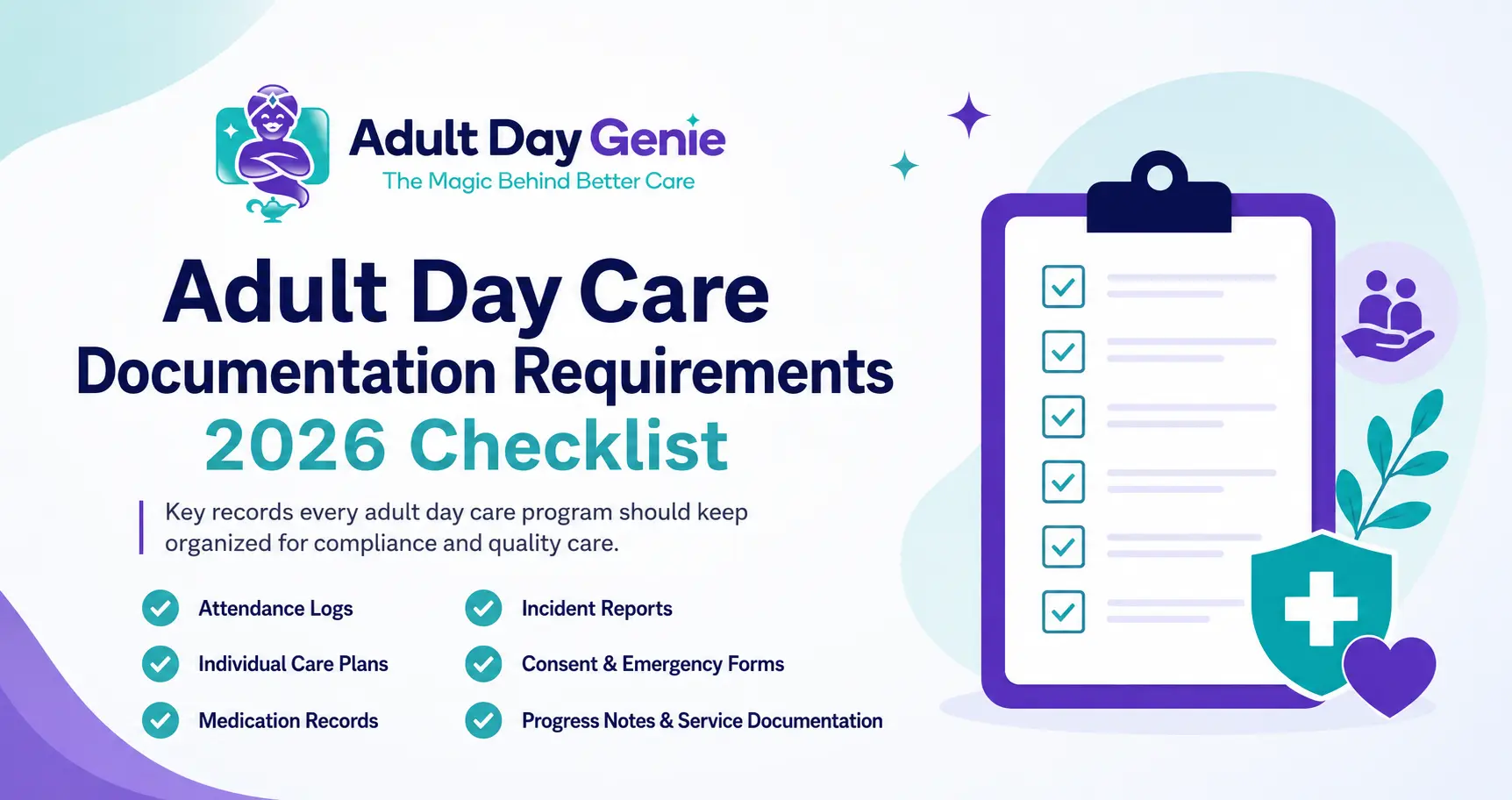
Adult day centers commonly maintain participant identification and emergency information, enrollment records, assessments, individualized care or service plans, daily attendance, progress or service notes, medication documentation where applicable, incident reports, activity and meal records, billing-supporting documentation, staff records, and administrative or safety records. This is a working framework rather than a universal legal checklist because exact requirements vary by state, Medicaid program, payer, center type, and funding source.
- Participant identification and emergency information
- Enrollment, consent, and authorization records
- Medical information where applicable
- Assessments and individualized care or service plans
- Daily attendance records
- Progress notes or service documentation
- Medication records where applicable
- Incident and accident reports
- Activity, meal, and nutrition records where required
- Medicaid or payer claim-supporting documentation
- Staff qualifications and training records
- Administrative, safety, and program records
The most useful starting question is not whether every adult day center needs exactly the same paperwork. It is: Which authorities govern our center, and what does each one require us to document?
Who Sets Adult Day Care Record Keeping Requirements?
State Licensing or Certification Rules
State rules may establish requirements for participant files, attendance, care plans, medication documentation, incidents, staffing files, safety records, program records, and record storage. Missouri provides a useful example. Its adult day care record keeping requirements address administrative, participant, and program records and include identifying information, individual plans of care, progress notes, attendance, medication documentation where applicable, and incident records.
Medicaid and HCBS Program Requirements
Centers billing Medicaid may face documentation requirements beyond what is required for state licensing. Depending on the program, documentation may need to identify the participant, date of service, type of service, start and stop times, staff member, authorized units, schedule, or other information supporting the service. Kansas Medicaid, for example, specifies detailed attendance information for certain adult day care services in its adult day care documentation guidance.
Managed Care Organizations and Other Payers
Managed care organizations and other payers can add requirements involving authorizations, approved schedules, service-plan updates, forms, units, claim submission, and records that must be produced during a review. A center should therefore check current provider manuals and payer contracts instead of assuming state licensing documentation will automatically satisfy billing requirements.
Other Funded Programs
Programs such as the Child and Adult Care Food Program can create another recordkeeping layer. For example, Indiana's published CACFP adult day care recordkeeping requirements include participant attendance, meal records, menus, and other program documentation. This is why centers should identify every authority that applies before building their final checklist.
Adult Day Care Documentation Checklist
| Record | What It Helps Document | Verify Against |
|---|---|---|
| Participant information | Identity, contacts, representatives | State rules, payer |
| Emergency information | Contacts and emergency needs | State rules, center policy |
| Medical information | Relevant health information where required | State or program requirements |
| Assessment | Participant needs, abilities, and risks | State, Medicaid, payer |
| Care or service plan | Goals, services, schedule, interventions | State, Medicaid, payer |
| Authorization | Approved dates, services, schedule, or units | Medicaid, MCO, payer |
| Attendance | Presence and potentially service duration | State, Medicaid, payer |
| Progress or service notes | Services, observations, changes, follow-up | State, payer, care plan |
| Medication records | Medication activity where applicable | State or clinical requirements |
| Incident reports | Accidents and unusual events | State rules, center policy |
| Activity records | Program activities and participation where required | State or program rules |
| Meal records | Meals, menus, and dietary documentation | State, CACFP |
| Billing support | Evidence supporting submitted claims | Medicaid, MCO, payer |
| Staff records | Qualifications, credentials, and training | Licensing requirements |
| Program records | Policies, safety, inspections, emergency planning | Licensing requirements |
For every important record, your team should be able to answer four questions: Who is responsible for it? When should it be completed? Which rule, program, or contract requires it? And where can the record be retrieved when someone asks for it?
What Should Adult Day Care Participant Records Include?
Adult day care participant records usually form the center of the documentation system because they connect information about the participant to the services the center provides. The exact contents vary, but a participant file may include identifying information, emergency contacts, authorized representatives, practitioner information, relevant medical information, assessments, the current care or service plan, attendance history, progress notes, medication documentation, incidents, payer authorizations, and other required records.
- Participant name and contact information
- Emergency contacts and authorized representatives
- Relevant health or practitioner information
- Initial and updated assessments
- Current individualized care or service plan
- Attendance history
- Progress or service notes
- Medication documentation where applicable
- Incident and accident reports
- Payer or Medicaid authorizations where applicable
A strong participant-record workflow also makes it easy to identify which care plan is active, when it became effective, what services are expected, and when it needs to be reviewed. The goal is not simply to collect documents. The participant's current plan, daily attendance, service documentation, and billing records should tell a consistent story.
What Should an Adult Day Care Attendance Record Show?
Attendance can become important evidence during billing reviews, audits, utilization questions, or disputes. Depending on the applicable rules, an attendance record may need to show participant identity, date, arrival or service start time, departure or service stop time, service or program, staff verification, required participant acknowledgement, and corrections or exceptions. Not every paper sign-in sheet will automatically satisfy every payer requirement. For a deeper explanation, see our guide to adult day care attendance tracking.
Attendance should also not automatically be treated as the same issue as federal Electronic Visit Verification. If your team is trying to determine whether EVV applies to your center-based services, read how EVV applies to adult day care.
What Are Adult Day Care Progress Notes?
Adult day care progress notes document relevant information about services, observations, participant response, changes, concerns, or follow-up. The required frequency is not universal. Rhode Island's adult day care licensing requirements, for example, require progress notes at specified intervals for licensed programs. That should be treated as a Rhode Island requirement rather than a nationwide frequency standard.
- What happened during the service or activity
- What service, intervention, or observation was relevant
- How the participant responded
- Whether an important change occurred
- Whether follow-up was needed
- Who created the note
- When the note was documented
Weak vs. Useful Documentation
A note such as Participant had a good day gives a reviewer very little objective information. A more useful note might state that the participant attended the morning music group for approximately 30 minutes, needed one verbal reminder during the transition to lunch, and reported no new concern to staff. The second version records observable information rather than only a general conclusion. Your state rules, payer requirements, care plans, and center policies should determine the exact format your staff use.
How Documentation Supports Medicaid Billing
Documentation and billing should not function as completely separate workflows. Depending on the program, a claim may need to be traceable through a chain such as authorization → attendance → required service documentation → units or service code → claim. The exact requirements vary by Medicaid program and payer. For a deeper explanation of how these records connect, see Medicaid billing for adult day centers.
An operational problem appears when billing staff have to reconstruct service dates, attendance, authorizations, or supporting documentation from paper forms, spreadsheets, and separate systems after the service day has ended. Even if each individual record exists somewhere, disconnected documentation makes review and claim preparation harder.
Adult Day Care Record Retention Requirements
There is no single nationwide adult day care record retention period that safely applies to every center and every record type. Retention can depend on state licensing rules, Medicaid requirements, payer contracts, employment requirements, program participation, investigations, and the type of record involved. Missouri provides one example: its adult day care recordkeeping rules generally require covered records to be maintained for at least five years unless otherwise specified. That does not mean five years should automatically be applied in every state or program.
| Record Type | Retention Period | Authority to Verify |
|---|---|---|
| Participant file | Verify applicable requirement | State, payer |
| Attendance | Verify applicable requirement | State, Medicaid, payer |
| Billing records | Verify applicable requirement | Medicaid, MCO, payer |
| Staff records | Verify applicable requirement | State and employment rules |
| Program records | Verify applicable requirement | Applicable funded program |
The safest approach is to maintain a written retention schedule that identifies the record type, required period, source of the requirement, storage location, and approved destruction process. Never adopt another center's retention period without confirming the authority supporting it.
Electronic Records, Corrections, and Audit Readiness
Moving from paper to software does not remove documentation obligations. It changes how staff create, access, correct, secure, and retrieve records. Washington's adult day center client record requirements, for example, specifically address secured electronic client-record systems. A good electronic workflow can make it easier to find the current participant record, access the active care plan, document attendance during the service day, identify incomplete records, control access, and retrieve information during a review.
Corrections should also be understandable. Rather than quietly replacing important history, a strong process can preserve what changed, when it changed, and who made the correction when appropriate. Adult Day Genie uses an append-only attendance correction model designed to preserve a clearer record trail. You can see how attendance, care plans, forms, reporting, and billing fit together on our adult day care software features page.
Documentation Requirements Vary by State
A national adult day care documentation checklist should never make state rules look interchangeable. Missouri emphasizes specific administrative, participant, and program records. Kansas Medicaid provides detailed attendance requirements for certain billed services. Rhode Island addresses participant files, care plans, and progress notes. Washington addresses secure client-record systems. CACFP participation can add meal and attendance documentation. If you operate a Social Adult Day Care program in New York, see our New York SADC documentation guide for a more specific look at that market.
How to Check Your Current Documentation Workflow
Choose one participant and one recent service date. Then test whether your center can retrieve the important records for that day without asking staff to reconstruct information from memory.
- Find the participant's current identifying and emergency information
- Find the applicable assessment and care plan
- Confirm the service authorization if one applies
- Retrieve the attendance record
- Find required progress or service documentation
- Identify relevant medication, incident, meal, activity, or transportation records
- Confirm the documentation supporting any payer claim
- Review whether corrections are understandable and traceable
If completing that exercise requires several spreadsheets, paper binders, shared folders, billing software, and staff memory, the problem may be the documentation workflow rather than employee effort. A strong system should make required records part of daily operations instead of forcing staff to rebuild the participant day afterward.
How Adult Day Care Software Can Help
Software does not make an adult day center compliant by itself. Regulators, Medicaid programs, managed care organizations, contracts, and other applicable authorities determine whether documentation satisfies their requirements. What software can do is reduce the gaps between the work staff perform and the records the center needs.
- Record attendance during the service day
- Keep participant information in one place
- Access current care plans and forms
- Complete daily documentation while details are fresh
- Track activities and meals
- Maintain a clearer correction history
- Produce operational reports
- Connect documentation with billing preparation
Adult Day Genie is designed around this connected participant-day workflow, helping centers keep attendance, participant records, care plans, forms, reporting, and Medicaid claim preparation closer together. If you are still evaluating systems, our guide on how to choose adult day care software explains what to review before moving away from paper or disconnected tools.
Frequently Asked Questions
What documentation is required for an adult day care center?
Adult day centers commonly maintain participant information, assessments, care plans, attendance, progress or service notes, medication and incident records, and program or billing-supporting records. Exact requirements vary by state, Medicaid program, payer, service type, and funding source.
What should be included in an adult day care participant record?
A participant file may include identifying and emergency information, relevant medical information, assessments, care plans, attendance, progress notes, medication documentation, incident reports, payer authorizations, and other records required by the state or program.
What should an adult day care attendance record contain?
Requirements vary, but common elements can include participant identity, date, arrival and departure or service times, service type, and staff verification. Medicaid programs or other payers may require additional information.
How often are adult day care progress notes required?
There is no universal nationwide frequency. Progress-note requirements depend on the state, payer, program, service type, and care model. Centers should verify the rules that specifically apply to their program.
How long should adult day care records be retained?
There is no single nationwide retention period for all adult day care records. State licensing rules, Medicaid requirements, payer contracts, record type, program requirements, and other applicable obligations can affect how long records must be kept.
Does adult day care software make a center compliant?
No. Software can support more complete, consistent, secure, and retrievable documentation, but the applicable regulator, Medicaid program, payer, or other authority determines whether the center's records satisfy its requirements.
A strong documentation system should make it easy to explain what must be documented, who is responsible, which authority requires it, how it connects to the participant's service day, how corrections are handled, and how records are retrieved. Want to see how your current attendance, participant documentation, and billing workflow could work in one connected system? Book an Adult Day Genie walkthrough and we'll show you how the same participant day can move from attendance through documentation and billing preparation.