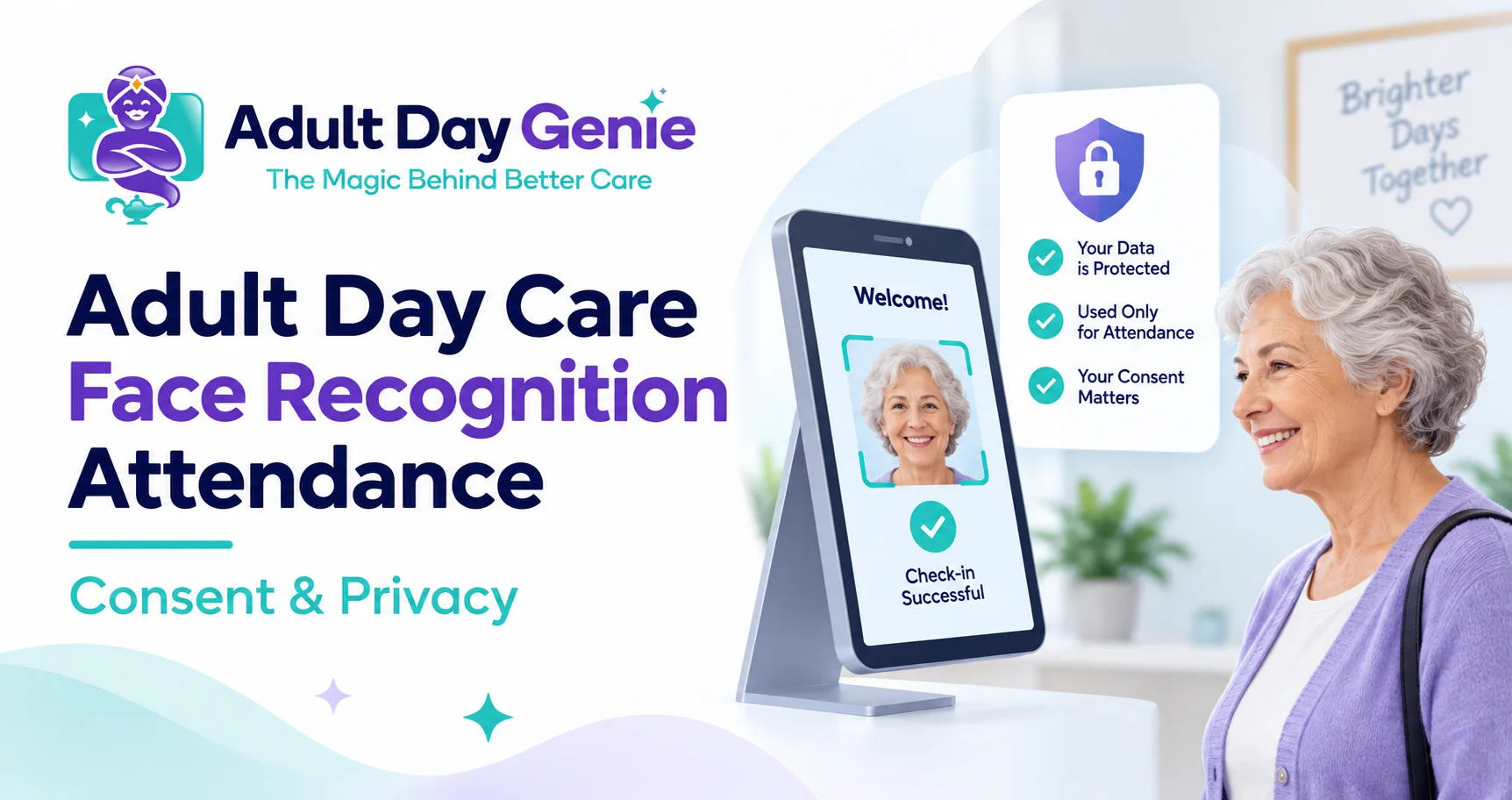
Face recognition can make participant check-in faster and reduce reliance on handwritten attendance, but the technology itself is only one part of a reliable attendance process. An adult day center also needs to know how consent is documented, what happens when someone cannot or does not use face verification, how corrections are recorded, who can access sensitive information, and whether the resulting record supports the center's operational and payer requirements. That is why adult day care face recognition attendance should be evaluated as both an identity-verification tool and part of a larger attendance-record workflow.
What Is Adult Day Care Face Recognition Attendance?
Adult day care face recognition attendance uses facial information to help confirm a participant's identity when recording an arrival, departure, or other attendance event. It is important to understand what the system actually does. NIST guidance on facial recognition distinguishes verification, where a face is compared with a claimed identity, from identification, where a face may be searched against a larger enrolled population.
For adult day centers, the practical question is not simply whether software offers facial recognition. The more useful questions are: how is the participant confirmed, what happens when face verification is not used, and what attendance record is preserved afterward? A well-designed adult day care biometric attendance workflow should make those answers clear to staff and administrators.
How Does Face Check-In Work?
- 1. The participant arrives at the adult day center.
- 2. Staff confirm the participant's profile and applicable consent status.
- 3. Face confirmation is used when appropriate.
- 4. A manual check-in option remains available when face confirmation is not used.
- 5. The arrival is recorded with the relevant timestamp.
- 6. Departure is recorded later using the center's established workflow.
- 7. If a mistake occurs, the correction remains traceable rather than silently replacing the original attendance event.
Adult Day Genie's adult day care attendance software supports consent-based face confirmation while keeping manual staff check-in available. This gives centers an alternative when face verification is declined, unavailable, or inappropriate while preserving the underlying attendance workflow.
Why Consent and Manual Fallback Matter
A center should not assume that one biometric-consent rule applies everywhere in the United States. Requirements may vary depending on the jurisdiction, the type of information collected, how it is stored or used, and the organizations involved. The FTC's biometric information guidance also highlights privacy and security risks associated with biometric technologies. For that reason, facial recognition attendance consent should be considered before implementation rather than after a problem occurs.
- How is consent or authorization recorded?
- What facial or biometric information does the system use or retain?
- What happens if face confirmation is declined?
- Can staff record attendance manually?
- How are camera, device, connectivity, or verification failures handled?
A manual alternative matters because an attendance process should not stop working simply because its preferred verification method is unavailable. Centers replacing paper processes should also review their broader digital attendance tracking for adult day care workflow so staff training, exceptions, correction procedures, and fallback processes are clear before rollout.
What Privacy Issues Should Adult Day Centers Review?
Facial recognition attendance privacy begins with understanding what information the system creates, stores, transmits, and retains. HIPAA should also be handled carefully. According to HHS guidance on covered entities and business associates, HIPAA applies to organizations that meet the relevant covered-entity or business-associate definitions; it does not automatically apply to every adult day program simply because health-related information is involved.
Where HIPAA does apply, HHS de-identification guidance identifies biometric identifiers and full-face photographic images among the identifiers relevant to its Safe Harbor method. Centers should evaluate those issues in the context of their own data and operations. For broader questions about PHI, BAAs, access controls, workforce responsibilities, and security safeguards, see the dedicated adult day care HIPAA compliance guide.
| Question | Why It Matters |
|---|---|
| What facial or biometric information is stored? | The center should understand exactly what information the technology retains. |
| Where is the information stored? | Storage location affects security, access, and vendor oversight. |
| Who can access it? | Access should reflect staff responsibilities and applicable requirements. |
| How long is it retained? | Retention practices should reflect applicable requirements and center policy. |
| How is deletion handled? | The center should understand what happens when information no longer needs to be retained. |
| Does a BAA apply? | This depends on whether HIPAA applies and the vendor's role. |
What Makes an Attendance Record Review-Ready?
A successful face match alone is not a complete attendance record. The more useful evidence is the history created around that event. Depending on the center's applicable program, payer, state, waiver, licensing, or contractual requirements, an attendance record may need to show who received the service, when they arrived, when they departed, how the attendance event was recorded, and what happened if the record was later corrected.
- Participant identity
- Service date
- Arrival time
- Departure time
- Check-in or recording method
- Staff attribution
- Original attendance entry
- Correction history
- Who made a correction
- When the correction occurred
Real-world attendance records sometimes need correction. A participant may be selected incorrectly, a departure may be missed, or staff may notice an error later. Silently replacing the original information can make the record harder to understand. A stronger workflow preserves enough history to show what was originally recorded and what changed afterward.
How Does Attendance Connect to Medicaid Records?
Face confirmation can support participant identification, but it does not by itself establish that a Medicaid claim is payable. Depending on the program and payer, billing may also depend on authorization, service dates, duration or units, eligibility, service documentation, care-plan requirements, and other rules.
A more useful workflow is: participant verification → attendance record → service documentation → authorization review → billing. This creates a natural connection between attendance and adult day care Medicaid billing software without treating facial recognition as proof that every billing requirement has been satisfied. The goal is to create stronger source documentation from the beginning of the workflow.
Is Face Recognition Attendance the Same as EVV?
No. Electronic attendance at an adult day center and Electronic Visit Verification may both record time-related information, but they should not automatically be treated as the same requirement. CMS Electronic Visit Verification guidance explains that the federal EVV mandate applies to specified Medicaid personal care services and home health care services that require an in-home visit.
A center-based adult day service takes place in a program setting rather than an in-home visit. State programs, waivers, managed-care organizations, payers, or contracts may still impose additional verification or documentation rules. For the broader distinction, see does EVV apply to adult day care.
Face Recognition vs. Manual Check-In
| Area | Face Confirmation | Manual Check-In |
|---|---|---|
| Identity workflow | Uses configured facial verification | Staff verifies and selects the participant |
| Biometric participation | Yes | No |
| Fallback role | Should have an alternative when unavailable | Can function as the non-biometric alternative |
| Arrival and departure records | Should be preserved | Should be preserved |
| Correction history | Should remain reviewable | Should remain reviewable |
| Best use | Optional identity-verification path | Reliable staff-managed attendance path |
The important outcome is not which method appears more advanced. It is whether the center ends up with a reliable, understandable attendance history that staff can manage during both normal operations and exceptions.
6 Questions to Ask a Facial Recognition Software Vendor
- 1. Is the system performing facial verification or facial identification?
- 2. How is consent or authorization recorded?
- 3. What happens when someone does not use face confirmation?
- 4. What facial or biometric information is stored, where is it stored, and for how long?
- 5. Can staff correct attendance without deleting or hiding the original history?
- 6. Can attendance, staff attribution, and correction records be exported when needed?
These questions reveal more about the quality of adult day care facial recognition software than a perfect check-in demonstration. Centers should test the exceptions too: declined face verification, incorrect participant selection, missed departures, device problems, and attendance corrections.
How Adult Day Genie Handles Face-Confirmed Attendance
Adult Day Genie uses a consent-aware attendance workflow designed for adult day centers. Staff select the participant at arrival. When the appropriate consent is recorded, face confirmation can be used. When face confirmation is not used, staff can record attendance manually instead.
The attendance history keeps the relevant arrival, departure, recording method, staff, and correction information together. That separates two important questions: how was the participant confirmed, and what evidence was preserved afterward? For administrators managing documentation and billing workflows, the second question is often the more important one.
Frequently Asked Questions
Is facial recognition required for adult day care attendance?
No universal federal requirement makes facial recognition mandatory for all adult day centers. Centers should verify the requirements that apply to their state, service, payer, waiver, licensing framework, and contracts.
Does facial recognition attendance require consent?
Requirements vary by jurisdiction and circumstance. Adult day centers should review applicable biometric privacy requirements, organizational policies, and vendor practices before using facial technology.
Does HIPAA apply to facial recognition attendance?
It depends on whether the organization is a HIPAA covered entity or business associate and whether the facial or attendance information is PHI or ePHI in that context.
Can facial recognition attendance guarantee Medicaid reimbursement?
No. Facial verification can support identity and attendance documentation, but reimbursement may also depend on authorization, service documentation, eligibility, units, payer rules, and other requirements.
Is facial recognition attendance the same as EVV?
No. Federal EVV requirements apply to specified Medicaid personal care and home health services requiring an in-home visit. Center-based adult day attendance is not automatically the same requirement.
Build the Record Around Evidence, Not Just the Camera
Adult day care face recognition attendance can make check-in easier, but the strongest workflow does more than recognize a face. It gives the center an appropriate consent process, a manual alternative, clear attendance history, traceable corrections, and records that can support later operational and billing review.
See how face confirmation and manual attendance work together in Adult Day Genie. Explore Attendance & Check-In to review how consent, participant check-in, corrections, and attendance history can be managed in one workflow and access the demo option for your center.