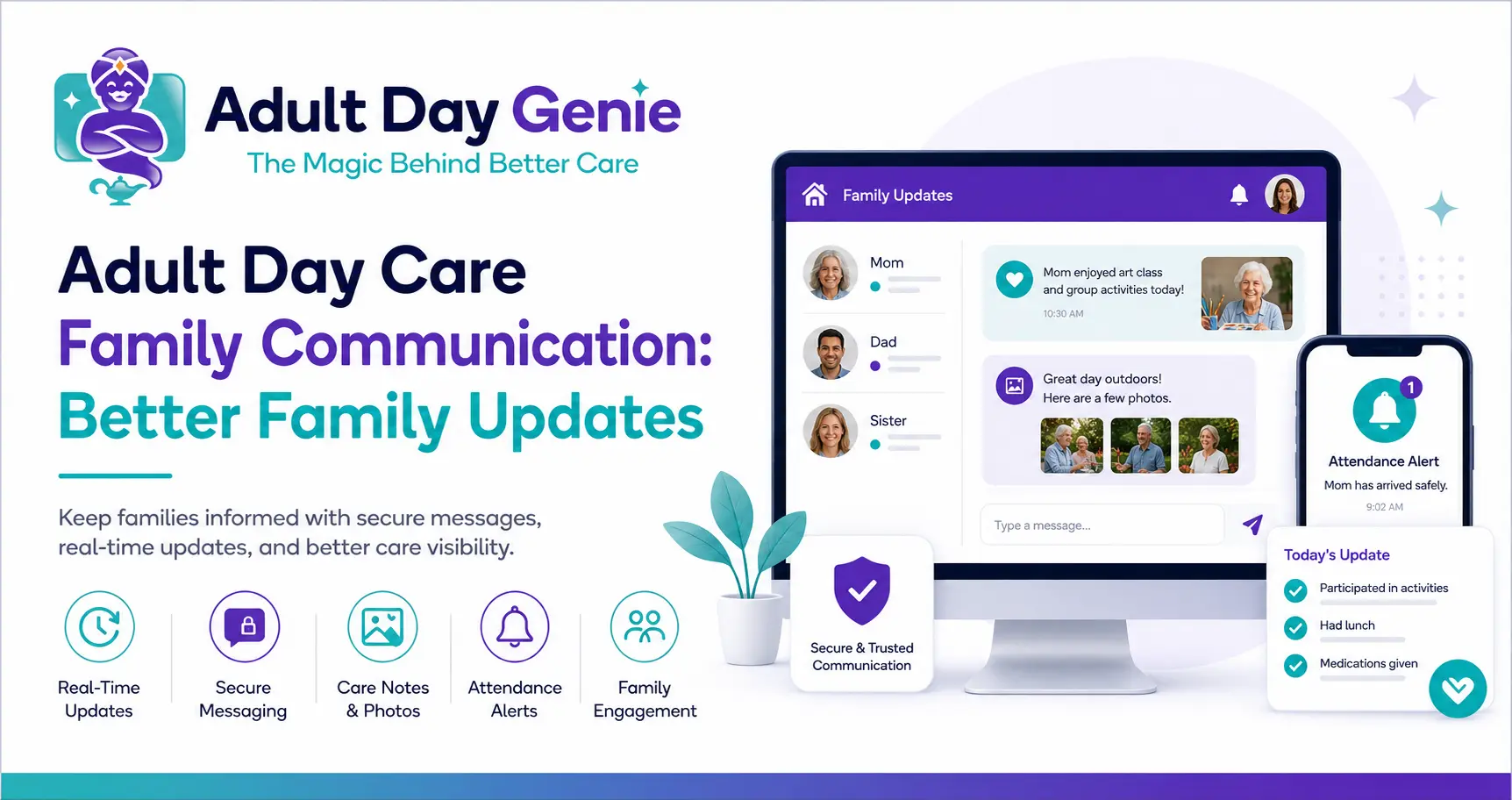
Families usually do not need a long report every afternoon. They need confidence that the person they care about had a meaningful day and that the center will contact them when something requires attention. Effective adult day care family communication therefore depends less on sending more messages and more on sending the right information to the right authorized person through the right channel. A practical system separates routine updates from issues that require a call, clinical follow-up, or the center's incident process. It also fits communication into documentation staff already complete instead of creating another end-of-day task.
Adult day centers should share concise, relevant updates with authorized family contacts on a predictable schedule while using separate escalation procedures for urgent, clinical, safety, or incident-related issues. Routine family communication should be easy for staff to create, appropriate for the recipient, and connected to the participant's documented day.
What Should Adult Day Centers Share With Families?
Useful adult day care family updates answer questions families genuinely care about without turning every internal care note into a family-facing message. Depending on the participant, the center's policies, the authorized recipient, and what happened that day, a routine update might include participation in activities, a positive moment, a relevant meal or program note, a reminder, or a follow-up item the family needs to know about. The goal is useful context, not a minute-by-minute transcript.
- Participation in activities or programs
- Meaningful social or recreational moments
- Relevant reminders for the participant's next visit
- Non-urgent follow-up requested from the authorized contact
- A brief and useful summary of the participant's day
- Photos or media when the center has the appropriate permissions
- Relevant information approved for family-facing communication
Internal documentation and family-facing communication are not the same thing. Staff may record information for clinical, operational, billing, compliance, or supervisory purposes that should not automatically be copied into a routine family message. A better process creates a deliberate family-facing layer rather than treating every note in the participant record as something relatives should receive.
Which Updates Can Wait, and Which Need a Call?
One of the most important adult day care family communication best practices is defining the escalation path before an issue happens. A portal notification or routine message should never become the default simply because it is convenient. Staff should know when a normal update is appropriate and when the situation requires direct contact or another center procedure.
| Situation | Recommended Communication Approach | Why |
|---|---|---|
| Routine activity or positive moment | Routine family update | Useful information that generally does not require immediate action |
| Reminder for the next visit | Routine message | Gives the family time to prepare without requiring a phone call |
| Question requiring family input | Message or call based on urgency | The response method should match how quickly an answer is needed |
| Significant change or concern | Follow center policy and use direct contact when appropriate | A passive message may not provide adequate confirmation or context |
| Time-sensitive safety matter | Follow the center's emergency or escalation procedure | Staff should not depend on someone noticing an app notification |
| Incident or reportable event | Follow required incident and notification procedures | Routine family messaging is not a substitute for required notification |
| Sensitive clinical discussion | Use the center's approved communication process | Privacy, context, and professional judgment may require direct conversation |
The practical rule is simple: communication technology should support the center's escalation policy, not replace it. Staff should understand which situations belong in a routine day summary, which require confirmation that someone received the message, and which trigger a separate clinical, supervisory, safety, emergency, or incident workflow.
How Often Should Adult Day Centers Send Family Updates?
There is no universal schedule that fits every program or participant. A workable communication cadence should give families useful visibility without turning staff into full-time message writers. For many adult day centers, consistency matters more than constant communication.
Use a Predictable Routine for Normal Updates
Choose a point in the day when staff have enough information to provide a meaningful update. Depending on the program, that might happen near pickup, after a major activity block, or as part of end-of-day documentation. Families should gradually learn what normal communication from the center looks like and when they can expect routine information.
Use Event-Based Communication When Action Is Needed
Do not make an important issue wait for the regular update simply because the daily message is scheduled later. If something requires timely family involvement, move it into the appropriate direct-contact or escalation workflow.
Do Not Confuse Frequency With Quality
Five generic notifications do not necessarily create more trust than one useful and specific summary. Instead of saying only that a participant had a good day, a message explaining that the participant joined the morning music group and remained engaged for the full session provides recognizable context without becoming unnecessarily long.
How to Communicate With Families in Adult Day Care Without Creating More Work
When directors ask how to communicate with families in adult day care, the operational problem is often as important as the communication itself. If staff document attendance in one place, activities somewhere else, write care notes in another system, and then open a separate messaging tool to reconstruct the participant's day, family communication becomes duplicate work.
A stronger workflow starts with information staff are already recording. The communication process should make it easy to confirm the recipient, select information appropriate for family sharing, review the message, choose the correct communication channel, and maintain a record of what was sent.
- Confirm the authorized recipient before preparing or sending the update
- Use the participant's existing daily record instead of relying on staff memory
- Separate internal documentation from family-facing language
- Review the family-facing update before it is sent
- Choose the communication channel based on routine versus urgent needs
- Maintain a record of who sent the communication, when it was sent, and who received it
- Keep the workflow simple enough for frontline staff to use consistently
Adult Genie is designed around this connected approach. Its authorized family updates are part of the same adult day center workflow as participant records, attendance, care plans, activities, and daily documentation, helping staff avoid rebuilding the participant's day in an unrelated communication system.
How Should Adult Day Centers Handle Privacy and HIPAA?
Privacy requires more thought than simply asking whether a communication platform is secure. One of the first operational questions is who is authorized to receive information and what information is appropriate to share with that person.
For covered health care providers, the U.S. Department of Health and Human Services explains that the HIPAA Privacy Rule can permit communication with family members, friends, or other people involved in a person's care or payment for care under applicable circumstances. HHS also explains that disclosures in these situations should be limited to information directly relevant to the person's involvement. Centers should review the official HHS guidance on communication with family and others involved in care when developing their procedures.
That does not mean every adult day center should automatically share every detail with every relative. The appropriate process may depend on the participant's wishes and capacity, the recipient's role, the program type, applicable federal and state requirements, payer or program rules, organizational policies, and the circumstances involved. Centers should establish their privacy and authorization procedures with appropriate professional guidance and then make sure their technology supports those procedures.
- Clear records identifying authorized family contacts or representatives
- Role-based staff access to participant information
- A visible recipient before an update is sent
- A practical process for changing or revoking access
- Separation between internal documentation and family-facing information
- A history of messages or updates sent
- Appropriate contractual and security safeguards when protected health information is involved
Should an Adult Day Center Use a Family Portal?
An adult day care family portal can be useful when it reduces fragmentation rather than adding another disconnected application to the center's day. The portal itself is not the communication strategy. The underlying workflow matters more.
A center evaluating a family portal should ask whether staff can determine exactly who receives information, whether family communication connects to participant records, whether communication history is available, whether access changes can be handled promptly, and whether preparing a routine family update requires staff to re-enter information they have already documented.
If your center is evaluating communication tools as part of a broader software purchase, use Adult Day Genie's adult day care software buyer's guide to evaluate family communication alongside attendance, documentation, security, reporting, billing, usability, implementation, support, and total cost.
Why Does Better Family Communication Matter?
Good adult day care family engagement is not simply about sending pleasant photos. Communication can give family caregivers useful visibility into a part of the participant's day they do not personally observe. That context can help families understand what happened during the service day, prepare for transitions between the center and home, and know when the center needs their input.
A mixed-methods feasibility study evaluating a digital communication tool in adult day centers serving people living with dementia reported caregiver and staff experiences related to reassurance, visibility into the participant's day, communication efficiency, and reduced phone tag. The study also highlighted the importance of structured guidance, usable workflows, and integration with existing systems. Centers interested in the research can review the CareMobi adult day center communication study.
The operational lesson is important: adding a family communication tool does not automatically improve communication. The center still needs clear decisions about what staff should share, who should receive it, what requires escalation, and how the communication task fits the work staff already perform.
What Should You Evaluate in Family Communication Software?
Software should make an established communication policy easier to follow rather than deciding the policy for the center. Before buying or configuring a system, ask the vendor to demonstrate a realistic participant day from arrival through documentation and family communication.
- How staff identify an authorized family contact
- What participant information is visible when preparing an update
- Whether internal documentation stays separate from family-facing content
- How a routine update is reviewed before it is sent
- Whether the system records the sender, recipient, date, and time
- What happens when family authorization changes
- Whether staff can communicate without recreating information
- How family updates connect with attendance and care documentation
- What security controls and contractual safeguards are available
- How frontline staff complete the workflow during a busy service day
For a more consistent vendor test, use Adult Day Genie's adult day care software comparison checklist and ask every vendor to demonstrate the same participant-day workflow instead of comparing feature lists alone.
A Simple Family-Update Workflow for Adult Day Centers
If your current process depends heavily on staff memory, personal phones, scattered email threads, or repeated calls, you do not need to redesign every communication process at once. Start with one predictable routine and make the escalation path equally clear.
- Identify which contacts are authorized to receive routine participant information
- Define which information belongs in a routine family update
- Define which situations must bypass routine messaging and trigger direct escalation
- Choose when routine summaries should be prepared
- Build the update from existing participant-day information whenever possible
- Require a quick staff review before sending
- Record what was sent, who sent it, who received it, and when
- Review recurring family questions and improve the workflow when important information is repeatedly missing
This creates a much clearer operating standard than simply telling staff to keep families updated. It also gives center leadership something concrete to train, monitor, and improve over time.
Family Communication Should Connect to the Day, Not Compete With It
Strong adult day care family communication should not require staff to document the same day twice. Families need useful visibility. Staff need a manageable process. Participants need appropriate privacy. Center leaders need confidence that routine messages and urgent communication are handled differently. The strongest workflow balances all four.
Adult Day Genie brings attendance, participant records, care plans, daily documentation, activities, and family updates into one adult day center workflow. If your center is considering replacing disconnected communication and recordkeeping tools, review Adult Day Genie's published pricing and evaluate how the workflow would fit your own staff and participants.
Frequently Asked Questions
What should an adult day center tell families each day?
A routine family update should focus on information that is useful to the authorized recipient, such as meaningful activities, relevant participation, reminders, or needed follow-up. Centers should avoid automatically copying internal documentation into family-facing messages and should use separate procedures for urgent, clinical, safety, or incident-related communication.
How often should adult day centers update families?
There is no single schedule that fits every center. Routine updates should follow a predictable cadence that staff can maintain and families can understand. Time-sensitive concerns should not wait for the normal update and should follow the center's direct-contact or escalation process.
Can adult day centers share information with family members under HIPAA?
Where HIPAA applies, HHS explains that covered health care providers may communicate relevant information with family members or others involved in a person's care or payment under applicable circumstances. The information shared should be limited to what is relevant to that person's involvement. Centers must also follow applicable laws, privacy policies, authorization procedures, and appropriate professional guidance.
When should staff call a family instead of sending a portal message?
Staff should use direct communication when an issue is urgent, requires timely confirmation or discussion, involves significant safety or clinical concerns, or triggers the center's incident or escalation procedure. A routine portal message should not replace emergency, clinical, or required notification processes.
What should an adult day care family portal include?
A useful family portal should help staff identify authorized recipients, keep internal notes separate from family-facing information, maintain communication history, control access when authorization changes, and send updates without forcing staff to re-enter information already documented elsewhere.
How can adult day centers reduce repetitive family phone calls?
Start by identifying the questions families ask most often and include appropriate answers in a predictable routine update. Connecting family communication to information staff already document can reduce repeated reconstruction of the participant's day while keeping direct calls available for issues that genuinely require conversation.