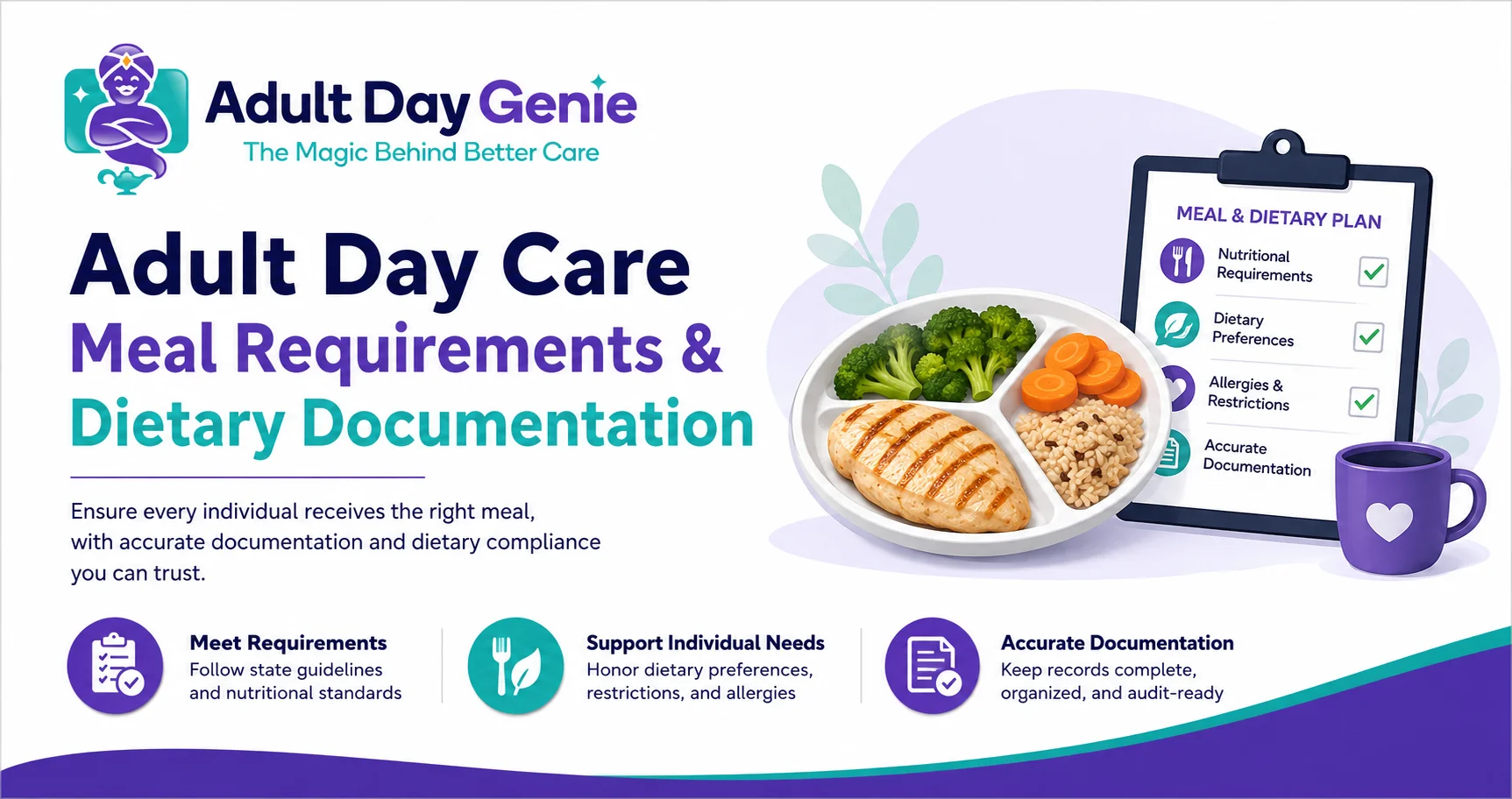
Providing meals in an adult day center involves more than deciding what goes on the menu. Centers may need to account for nutrition standards, participant dietary needs, daily meal records, attendance, and, for programs participating in the Child and Adult Care Food Program (CACFP), specific meal-pattern and reimbursement requirements. Adult day care meal requirements vary by state, program, payer, and whether the center participates in CACFP. The goal is to document what was planned, what was actually served, and which participants received qualifying meals.
Quick answer: Adult day centers should verify which meal rules apply to their program, follow applicable meal-pattern requirements, document meals actually served, maintain required meal-count and attendance records, and keep participant dietary modifications current and accessible to staff.
This guide provides general operational information, not legal, nutrition, or reimbursement advice. Always verify current requirements with your state licensing agency, CACFP state agency or sponsor, payer, and applicable program rules.
Do CACFP Meal Requirements Apply to Every Adult Day Care Center?
No. CACFP is a federal nutrition program administered through state agencies, and adult day care centers must meet program eligibility requirements to participate. Participating centers may receive reimbursement for qualifying meals and snacks served to eligible adult participants. USDA's CACFP Adult Day Care Handbook explains the federal requirements that participating centers should follow.
That means operators should separate two questions: what meal requirements apply to the adult day care program generally, and what additional requirements apply because the center participates in CACFP? Centers outside CACFP may still have state licensing, food-service, dietary, care-plan, or contract requirements.
CACFP Adult Day Care Meal Requirements
CACFP adult day care meal requirements are based on defined meal components rather than simply serving a meal that appears balanced. For adult participants, the meal pattern includes fluid milk, vegetables, fruits, grains, and meats or meat alternates. The specific components and minimum serving quantities depend on the type of meal being served.
| Meal | General CACFP Structure for Adults |
|---|---|
| Breakfast | Milk, vegetables or fruits, and grains |
| Lunch | Required meal components under the adult meal pattern |
| Supper | Required meal components with applicable adult meal-pattern flexibilities |
| Snack | Two qualifying meal components |
USDA publishes current CACFP nutrition standards and meal patterns, including minimum quantities and crediting requirements. Centers should use current federal and state guidance when planning reimbursable meals rather than relying on an old menu template.
What Adult Day Care Meal Documentation Should Be Kept?
Good adult day care meal documentation should answer three different questions: what meal was planned, what was actually served, and which participants actually received the meal. These should not automatically be treated as the same record.
- Dated menus
- Food items and required serving information
- Participant enrollment or eligibility records where applicable
- Daily attendance
- Daily meal counts
- Menu substitutions or changes
- Dietary and meal-modification records
- Other documentation required by the state agency or sponsor
A planned lunch does not prove that every scheduled participant received that lunch. Meal documentation should therefore remain connected to accurate adult day care attendance tracking so staff can reconcile meals with the people who were actually present.
What Are Adult Day Care Meal Count Records?
Adult day care meal count records document meals actually served to participants. For CACFP programs, centers should maintain daily attendance and daily meal-count information using the method required by the applicable state agency or sponsor.
- Menu — what the center planned to serve
- Attendance — who was actually present
- Meal count — which qualifying meals were actually served
Those records should make sense together without being treated as interchangeable. USDA CACFP monitoring guidance uses reconciliation between meal counts, attendance, and enrollment to identify potentially inconsistent records. Its five-day reconciliation guidance shows why centers should be able to explain significant differences between attendance and claimed meal counts.
Should Meal Records Match Attendance?
Meal records and attendance should be logically consistent, but they do not have to be identical. Attendance shows who was present. A meal count shows which qualifying meals were actually served. A participant might arrive after breakfast, leave before a snack, or have another documented circumstance that explains why the records differ.
- Do not automatically count every scheduled participant
- Record meals according to the method required by your program
- Keep attendance accurate for the actual service day
- Review unexplained differences while the day is still recent
- Document corrections according to your recordkeeping procedures
This is where connected adult day care documentation requirements become important. Meal records, attendance, participant information, and other service-day documentation should tell a consistent story rather than living in separate systems that staff have to reconcile weeks later.
Adult Day Care Special Diet Documentation
Participant dietary needs should not live only in staff memory. Adult day care special diet documentation may involve allergies, food intolerances, texture modifications, disability-related meal changes, religious or personal preferences, or other individualized meal needs.
The exact documentation depends on the reason for the modification and the program involved. Under CACFP, certain disability-related modifications outside the standard meal pattern require supporting documentation. Current CACFP special-diet guidance explains when medical statements are required and who may provide them.
- What dietary modification is required
- Foods that should be avoided where applicable
- Acceptable substitutions or alternatives
- Who authorized or documented the modification
- When the dietary information was received or updated
- Which staff need access to the information
The goal is not simply to store a form. Staff responsible for planning, preparing, or serving meals should have access to current participant dietary information when they need it.
A Simple Meal Documentation Review
Before meal records are finalized or used to support reimbursement, complete a short review. Small documentation differences are easier to resolve while the service day is still recent.
- Was the correct menu documented?
- Were applicable meal-pattern requirements followed?
- Were actual meals recorded rather than assumed from the schedule?
- Do meal counts make sense compared with attendance?
- Are substitutions or exceptions documented where required?
- Are participant dietary modifications current?
- Is required supporting documentation on file?
- Can staff retrieve the records if a reviewer requests them?
How Adult Day Genie Fits Into the Meal Workflow
Nutrition regulations and CACFP eligibility decisions come from government agencies and program authorities, not from adult day care software. Software can, however, make the daily operational record easier to manage.
Adult Day Genie brings attendance, participant information, documentation, meals, dietary flags, authorizations, and other daily operations into a connected workflow. That makes it easier for staff to work from current participant information rather than disconnected spreadsheets or paper notes.
The operational chain should be clear: participant → attendance → dietary needs → meal → documentation. For centers trying to simplify those records, the right adult day care software can help keep the service-day workflow connected without replacing the state or CACFP rules the center is responsible for following.
Frequently Asked Questions
Do all adult day care centers have to follow CACFP meal requirements?
No. CACFP requirements apply to centers participating in the Child and Adult Care Food Program. Other adult day centers must follow the state licensing, payer, contract, food-service, and participant-care requirements that apply to their programs.
What are the adult day care meal pattern requirements under CACFP?
CACFP uses defined meal components for adult participants. Breakfast, lunch, supper, and snacks each have specific component and minimum quantity requirements under the current USDA adult meal pattern.
What adult day care meal documentation should be maintained?
Depending on the program, records may include menus, daily meal counts, attendance, enrollment or eligibility information, dietary modifications, substitutions, and other documentation required by the state agency or CACFP sponsor.
Should adult day care meal count records match attendance?
Meal counts and attendance are separate records, but they should be logically consistent. Attendance identifies who was present, while meal counts document qualifying meals actually served.
What documentation is needed for a special diet in adult day care?
Requirements depend on the program and reason for the modification. Under CACFP, certain disability-related meal modifications outside the meal pattern require supporting documentation from an authorized professional.
Adult day care meal requirements are easier to manage when menus, meal records, attendance, and participant dietary information are treated as parts of the same service day rather than separate paperwork. Verify the requirements that apply to your program, document what was actually served, keep dietary information current, and reconcile meal records before reimbursement records are finalized. Adult Day Genie helps adult day centers connect meals, dietary flags, attendance, participant documentation, and other daily operations in one workflow. See Adult Day Genie in 15 minutes to see how your center can build a clearer daily record.