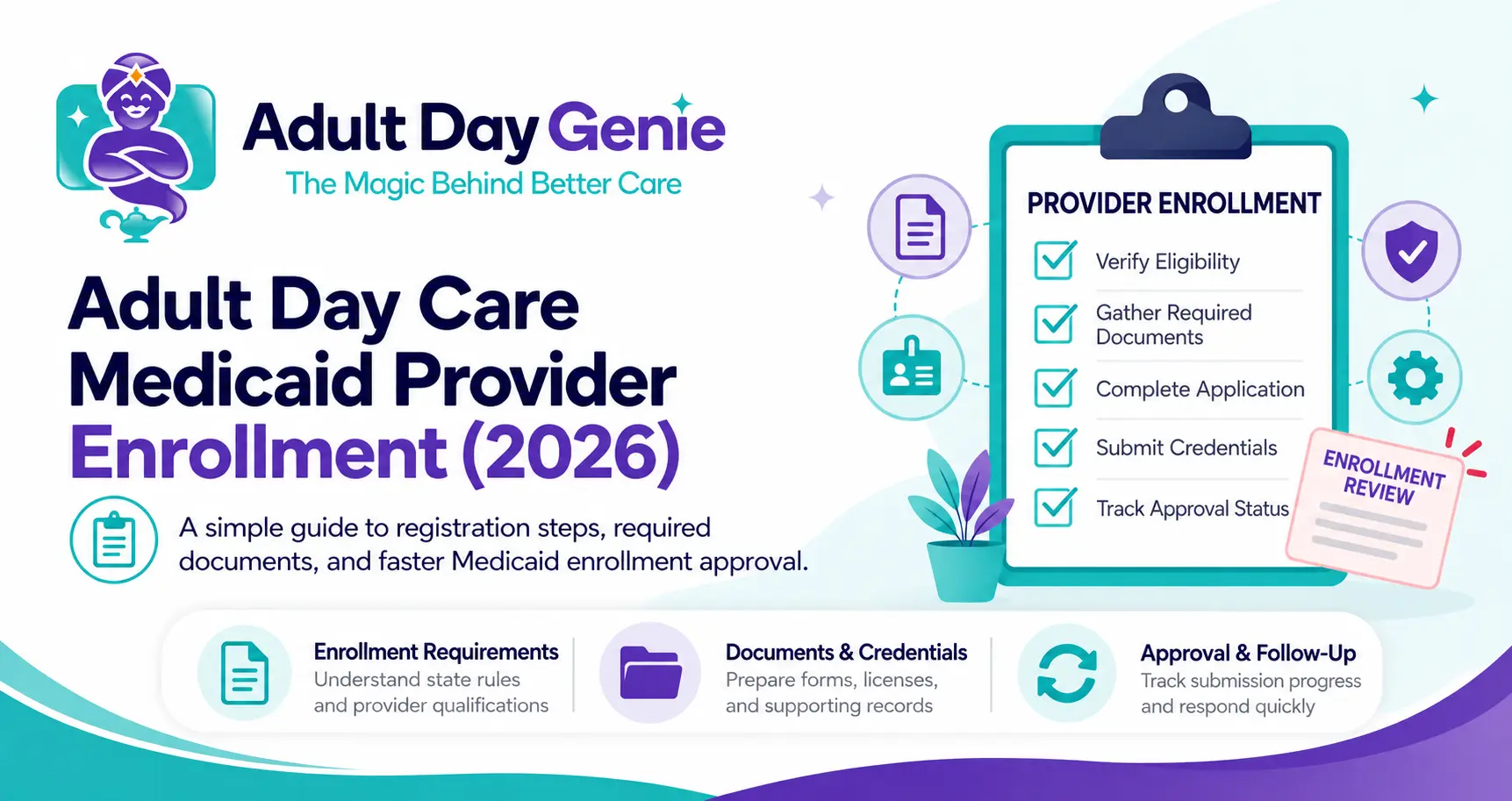
Adult day care Medicaid provider enrollment is not one universal application. A center may need to satisfy several separate requirements before Medicaid-funded services can turn into payable claims: licensing or certification, provider identification, state Medicaid enrollment, screening, managed-care or waiver contracting, and claims setup.
The exact sequence varies by state and program. An Adult Day Health provider in one state may follow a different enrollment path from a Social Adult Day Care or HCBS provider elsewhere. This guide explains the framework so adult day operators can understand which step they are working on—and avoid confusing an NPI, Medicaid enrollment, an MCO contract, or claims connectivity with one another.
How Do You Become a Medicaid Provider for Adult Day Care?
The process usually starts by identifying the exact adult-day service and provider type recognized by your state. From there, the center may need to meet licensing or certification requirements, determine whether an NPI applies, complete state Medicaid enrollment and provider screening, establish any required managed-care or waiver relationships, and finish electronic payment or claims setup.
Missouri, for example, requires Adult Day Care programs serving MO HealthNet waiver participants to enroll with the state's Medicaid enrollment authority before reimbursement. The key word is usually: Medicaid programs are administered by states, so do not assume another state's checklist applies to your center.
Medicaid Enrollment Is Not the Same as Adult Day Care Licensing
One of the most common mistakes is treating licensing and Medicaid enrollment as the same approval. They serve different purposes.
| Step | Main Purpose |
|---|---|
| Adult day license or certification | Establishes that the program may operate or provide a defined service under applicable state rules |
| NPI or other provider identifier | Identifies a provider for applicable administrative transactions |
| State Medicaid enrollment | Enrolls and screens the provider for Medicaid participation |
| MCO or waiver contracting | Establishes a network or payment relationship where required |
| Claims setup | Connects the enrolled provider to the payer or clearinghouse for electronic billing |
A center can therefore be licensed but not yet Medicaid enrolled. It can also have an NPI without being enrolled with Medicaid or contracted with a managed-care organization. CMS explains in its NPI guidance that obtaining an NPI does not itself license, credential, enroll, guarantee payment to, or create health-plan participation for a provider.
Step 1: Identify the Adult Day Service You Are Enrolling
Before filling out an application, determine how your state classifies the service. The provider or service category can affect licensing, NPI requirements, Medicaid enrollment, screening, billing codes, and payer relationships.
- Adult Day Care
- Adult Day Health
- Social Adult Day Care
- Adult Day Services
- HCBS adult day service
- Waiver adult day service
Do not choose a provider type simply because its label sounds similar to your business. Use the classification recognized by the Medicaid program, waiver, or managed-care arrangement you intend to serve.
Step 2: Confirm Licensing or Certification Requirements
Many adult-day Medicaid enrollment paths require the center to demonstrate that it meets the licensing, certification, or program-approval requirements associated with the service. This does not always mean the same agency controls both approvals.
- Identify which agency regulates your adult day program
- Confirm whether a license or certification must already be active
- Verify that Medicaid recognizes your exact service type
- Check whether the service location must appear on the license
- Confirm whether ownership or management changes must be reported
Treat the adult day license and Medicaid enrollment as connected—but separate—workstreams.
Step 3: Check Adult Day Care NPI Requirements
Do not assume every adult day provider follows the same NPI rule. An NPI is a unique provider identifier issued through the National Plan and Provider Enumeration System, or NPPES. For health care organizations, the relevant identifier is commonly a Type 2 organizational NPI, but provider classification and state requirements matter.
Arizona provides one example of why adult day care NPI requirements must be verified carefully. Its Medicaid provider-enrollment materials classify Adult Day Health as an atypical facility, agency, or organization provider type for which an NPI may not be required. New York provides a different example: current MLTC policy requires contracted Social Adult Day Care locations to obtain site-level organization NPIs, with separate NPIs for separate SADC locations.
The correct rule therefore depends on the state, program, provider type, and payer arrangement. An NPI should also never be treated as a substitute for Medicaid enrollment.
Step 4: Complete State Medicaid Provider Enrollment
Once you know the correct provider type and prerequisite approvals, the next stage is the state's Medicaid enrollment process. Exact adult day care Medicaid provider requirements differ, but applications commonly request several categories of information.
- Legal business name and tax information
- Ownership and controlling-interest disclosures
- Service-location information
- License or certification documentation
- Required provider identifiers
- Banking and Electronic Funds Transfer information
- Contact and managing-employee information
- Provider agreements and attestations
- HCBS-related assurances where applicable
- Application fees or additional screening where applicable
Missouri's official Adult Day Care waiver provider enrollment requirements provide a useful state example, including EFT information, ownership and control disclosures, facility documentation, and HCBS-related supporting records. Treat another state's requirements as an example—not as your own application checklist.
Step 5: Understand Medicaid Provider Screening
Medicaid enrollment is also a program-integrity process. CMS requires providers to be screened according to their categorical risk level during initial enrollment and revalidation. The exact screening activities can differ based on provider category and state implementation.
- License and certification verification
- Federal and state database checks
- Ownership and control disclosures
- Site visits where applicable
- Application fees where applicable
- Fingerprint-based criminal background checks for certain high-risk provider categories
See the official Medicaid provider screening and enrollment guidance for the federal framework. Do not assume that all adult day care providers fall into one national risk category; state provider classifications and program rules matter.
Step 6: Separate Medicaid Enrollment From MCO Contracting
Adult day care MCO contracting is another area where operators often get confused. Being enrolled with the state Medicaid program does not necessarily mean the center automatically belongs to a managed-care network.
| State Medicaid Enrollment | MCO Contracting or Credentialing |
|---|---|
| Managed through the state Medicaid enrollment system | Managed by the health plan or contracted entity |
| Establishes Medicaid enrollment and screening status | Establishes network participation or a contractual payment relationship |
| May require provider identifiers and ownership disclosures | May add plan-specific credentialing or contracting requirements |
| Does not automatically create an MCO contract | Does not replace required state Medicaid enrollment |
Some states or programs may also use HCBS waiver agencies or other intermediaries instead of a simple fee-for-service or MCO relationship. Confirm who actually authorizes the service and who pays the claim before building the center's billing workflow.
Step 7: Set Up the Payment and Claims Connection
Approval as a Medicaid provider is not necessarily the last technical step before billing. Depending on the state and payer, the center may also need to complete electronic payment, remittance, trading-partner, clearinghouse, or payer-specific setup.
- Electronic Funds Transfer setup
- Electronic Remittance Advice enrollment
- Payer or trading-partner registration
- Clearinghouse configuration
- Payer IDs
- Provider taxonomy or service-location configuration
- Electronic claims agreements
- MCO-specific portal registration
Keep the legal business name, tax information, identifiers, service locations, and provider information consistent across systems. Small mismatches can become significant billing problems. Once this stage is complete, use our 837P claims guide for the claim-format and submission side of the workflow.
Step 8: Prepare for the First Medicaid Claim
Provider enrollment makes billing possible. It does not make every service automatically billable. Before the first claim is submitted, confirm that both provider-level and participant-level requirements are ready.
- Medicaid provider enrollment is active
- The correct service location is enrolled where required
- Any required MCO or waiver relationship is active
- The participant is eligible for the applicable program
- Authorization is active where required
- The correct service code is selected
- The correct billing unit is used
- Attendance supports the billed service date
- Required care or service documentation is complete
- Provider identifiers match payer records
- Electronic claims setup is active
This is where adult day care authorization tracking becomes especially important. Enrollment answers whether the provider can participate; authorization addresses whether a specific participant or service is approved for a defined period, quantity, or payer.
Common Adult Day Care Medicaid Enrollment Mistakes
Many enrollment and first-claim problems happen because different stages of the process are treated as if they are interchangeable.
- Assuming an NPI means the center is Medicaid enrolled
- Using the wrong provider or service type
- Applying before required licensing or certification is complete
- Submitting inconsistent legal names, tax IDs, addresses, or identifiers
- Assuming state Medicaid enrollment automatically creates an MCO contract
- Missing service-location enrollment requirements
- Trying to bill before the enrollment or contract effective date
- Completing enrollment but not payer or clearinghouse setup
- Missing ownership or management disclosures
- Ignoring Medicaid provider revalidation notices
If claims are rejected after enrollment, use the adult day care Medicaid claim denials guide to determine whether the issue involves enrollment data, participant authorization, coding, documentation, eligibility, or another payer edit.
Do Adult Day Care Locations Need Separate Enrollment?
Sometimes—but this is another rule that should not be generalized nationally. Some state programs require separate enrollment or provider identification for individual service locations, while others structure multi-location participation differently.
Missouri, for example, states that each location providing Adult Day Care services to MO HealthNet participants must enroll separately. New York's Social Adult Day Care policy also uses location-level NPI requirements in its MLTC framework. Before adding another site, confirm whether your state or payer requires a separate provider ID, NPI, enrollment record, contract, or service-location affiliation.
Medicaid Provider Revalidation Does Not End After Approval
Medicaid enrollment must be maintained. Under the federal Medicaid framework, state Medicaid agencies must revalidate enrolled providers at least every five years, although states may require revalidation more frequently. Providers are screened again during revalidation according to the applicable risk level.
- Medicaid revalidation deadlines
- Adult day license or certification renewals
- NPI and NPPES updates where applicable
- Ownership or controlling-interest changes
- Service-location changes
- Banking or EFT changes
- MCO renewals or credentialing
- Required provider attestations
Enrollment data should be treated as living operational information, not a file that is completed once and forgotten.
From Medicaid Enrollment to Daily Billing
A useful way to think about the complete revenue path is: provider enrollment → payer relationship → participant eligibility → authorization → attendance → documentation → code and unit → claim → payer response.
Adult Day Genie's role begins in that downstream operational workflow—not in approving or enrolling an organization as a Medicaid provider. Once the required provider and payer relationships are active, Adult Day Genie can connect participant authorizations, attendance, daily documentation, and Medicaid billing in one adult-day-specific record.
For the next step, review our adult day care Medicaid billing software guide to understand how service-day records can move toward claim readiness without rebuilding the day from disconnected spreadsheets.
Adult Day Care Medicaid Provider Enrollment FAQs
How do I become a Medicaid provider for adult day care?
Start by identifying your state's exact adult-day provider or service type. Then confirm licensing or certification requirements, determine whether an NPI applies, complete state Medicaid enrollment and screening, and finish any required MCO, waiver, payer, or claims setup.
Does every adult day care center need an NPI for Medicaid?
No universal rule applies to every adult-day program. NPI requirements depend on provider classification, state rules, program type, and payer arrangements. Verify the requirement for your specific Medicaid program before applying.
Is an NPI the same as Medicaid enrollment?
No. An NPI identifies a provider for applicable administrative transactions, but it does not itself license, credential, enroll, or guarantee payment to the provider.
Is Medicaid provider enrollment the same as MCO credentialing?
No. State Medicaid enrollment and managed-care contracting or credentialing are separate processes. Depending on the state and program, a provider may need state enrollment before participating with an MCO.
How long does adult day care Medicaid provider enrollment take?
There is no reliable national processing time. Timing depends on the state, provider type, completeness of the application, required screening, site visits, missing documentation, and any separate MCO or waiver process.
How often do Medicaid providers have to revalidate?
Under the federal Medicaid framework, state Medicaid agencies must revalidate providers at least every five years, although individual states may require revalidation more frequently.
Build the Enrollment-to-Claim Workflow Correctly
Getting enrolled is only the beginning. Your center still needs participant eligibility, authorizations, accurate attendance, required documentation, correct billing codes and units, and a clean claims process after provider approval.
If those steps are spread across paper, spreadsheets, payer portals, and separate billing tools, Adult Day Genie can show you how the service-day record stays connected from attendance through documentation and Medicaid claim preparation. See Adult Day Genie plans and book a walkthrough.