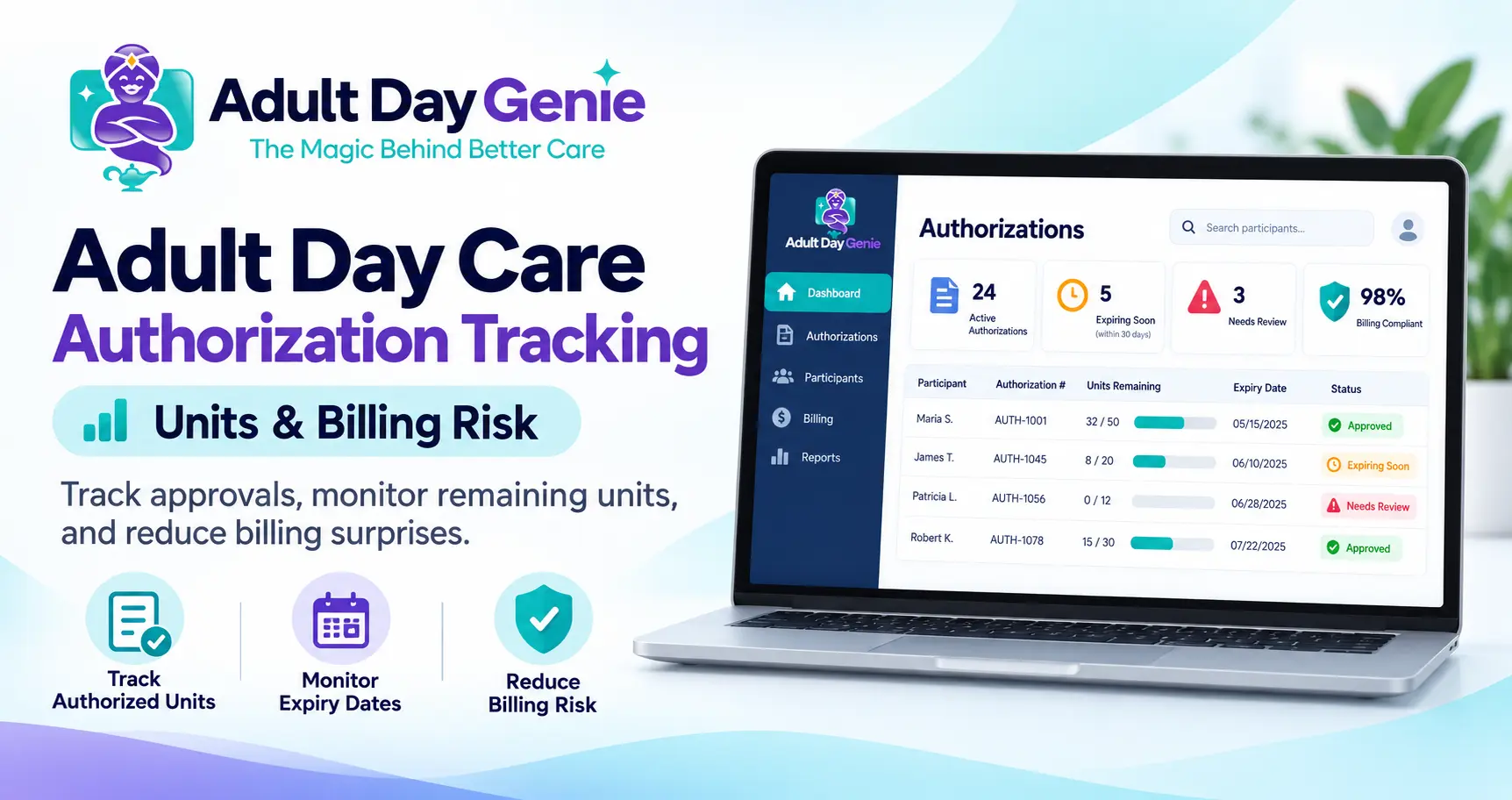
A participant can have complete attendance and good daily documentation and still have an authorization problem. The service may fall outside an approved date range, an authorization may have expired, or the service delivered may not match what was approved. That is why adult day care authorization tracking should happen before the claim stage. Centers need a practical way to connect the participant's authorization with the service date, attendance, documentation, and billing workflow instead of discovering a mismatch after the service has already been delivered.
Authorization requirements vary by state, Medicaid program, managed care organization, payer, waiver, and service. The goal is not to create one national rule. It is to build a workflow that makes the applicable authorization easy for staff to find, verify, and relate to the participant's actual service record.
What Is Adult Day Care Authorization Tracking?
Adult day care authorization tracking is the process of recording and monitoring the approval associated with a participant's covered service. Depending on the payer or program, that may include the approved service, effective date, end date, authorization number, frequency, units or other service limits, and renewal status.
Adult day care prior authorization requirements are not uniform nationwide. For example, Missouri Medicaid requires covered adult day care services to be prior authorized and applies program-specific unit rules. Other Medicaid programs and managed care plans may use different requirements, timelines, and authorization structures. Centers should therefore verify the rules that apply to each participant rather than relying on a generic authorization checklist.
What Information Should an Adult Day Center Track?
The exact fields depend on the payer and program, but effective adult day care authorization management starts with the actual authorization document and the requirements that apply to that participant.
| Authorization Field | Why It Matters |
|---|---|
| Participant | Confirms who the approval applies to |
| Payer or program | Identifies the source of the authorization |
| Approved service | Shows which service was authorized |
| Authorization number | Helps match records where applicable |
| Effective date | Shows when the authorization begins |
| End date | Shows when the current authorization ends |
| Approved units or limits | Shows the authorized amount where applicable |
| Utilization | Helps compare delivered service with the approval where required |
| Status | Shows whether the authorization is current, pending, expired, or in another applicable state |
| Renewal information | Helps staff identify follow-up needs |
Not every payer uses every field. Staff should avoid carrying assumptions from one Medicaid program or managed care plan into another.
Why Authorization Tracking Should Happen Before Billing
Authorization management is sometimes treated as a billing-office problem, but operationally it begins much earlier. A cleaner workflow is: Participant → Authorization → Schedule → Attendance → Documentation → Billing Review → Claim.
Before a service date reaches billing, staff should be able to determine which adult day care service authorization applies to the participant and whether the delivered service aligns with the information on file. Authorization does not replace attendance or documentation. Authorization answers what was approved, attendance establishes the participant's presence, documentation records what happened during the service, and billing represents what is submitted for reimbursement.
If your center is reviewing how service time relates to claim units, see our adult day care billing units guide for a deeper explanation of attendance, hours, and billing-unit mismatches.
How Do Adult Day Care Authorization Units Work?
There is no single nationwide structure for adult day care authorization units. Depending on the program, approved services may be measured using units, hours, days, visits, frequencies, date ranges, or another payer-specific method.
For example, the Missouri Adult Day Care Program Manual states that its adult day care services are authorized and billed in 15-minute units and applies program-specific limits. That is useful as a state example, but it should not automatically be applied to another Medicaid program.
- Confirm which service or procedure the authorization covers
- Verify how the payer measures the authorized service
- Check the effective and end dates
- Review any applicable frequency, unit, or utilization limit
- Confirm how the delivered service should be documented
- Verify the authorization information before billing
What Happens When an Authorization Is Near Expiration?
An expired authorization should not be something the billing team discovers after a claim has already been prepared. The correct response depends on the payer or program. Staff may need to verify the current approval, review renewal requirements, contact the appropriate plan or agency, or pause billing until the situation is clarified.
A practical adult day care authorization renewal workflow should give staff enough visibility to identify the applicable end date before it becomes a service or billing problem. MassHealth, for example, has Adult Day Health-specific prior authorization requirements, so Massachusetts providers should follow the current MassHealth ADH guidance rather than assuming another state's process applies.
The practical principle is simple: know the authorization status before relying on it.
How Should Authorization Connect With Attendance and Documentation?
A service authorization becomes more useful operationally when staff can follow it into the participant's actual service record. For one service date, an authorized user should be able to move from Participant → Authorization → Attendance → Daily Documentation → Billing Review.
Attendance should remain its own record. If your center is evaluating what information it currently captures, our adult day care attendance sheet template provides a separate reference for attendance records and digital tracking.
Documentation also remains distinct. An authorization may establish what was approved, but the service record should document what actually occurred. See our adult day care documentation requirements guide for a deeper look at participant records, service documentation, and record readiness.
The goal is not to merge every record into one oversized form. It is to make the relationship between the records clear enough that staff do not have to rebuild the participant's service day from several disconnected systems.
Spreadsheet vs. Connected Authorization Workflow
Many centers can track authorization dates in a spreadsheet. The operational challenge appears when that spreadsheet must be reconciled with participant records, attendance, documentation, and billing.
| Workflow | Separate Spreadsheet | Connected Participant Workflow |
|---|---|---|
| Find authorization | Search another file | Access with participant information |
| Verify service date | Manually compare dates | Review alongside the participant workflow |
| Compare attendance | Open separate attendance records | Follow the same participant and date |
| Review documentation | Search another location | Retrieve related service records |
| Prepare for billing | Reconcile several sources | Review connected information before claim preparation |
| Review record history | Depends on spreadsheet practices | Use structured record history where supported |
Going digital is not automatically better if staff still have to re-enter the same information in several places. A better question is: how many systems does your team need to open to understand one participant's authorized service day?
How to Audit One Participant's Authorization Workflow
You do not need a large compliance project to test the process. Choose one participant and one recent service date, then follow the record from authorization through billing review.
- Locate the participant's current authorization
- Confirm the payer or program
- Verify the approved service
- Check the effective and end dates
- Review applicable units or limits
- Open attendance for one service date
- Retrieve the related service documentation
- Follow the record into billing review
If the team cannot complete those steps without reconstructing information from spreadsheets, binders, or multiple disconnected systems, you have found an operational gap. For a broader record-readiness review, use the Adult Day Care Audit Checklist.
How to Evaluate Authorization Tracking Software
When comparing systems, do not ask only, "Do you support authorizations?" Ask the vendor to demonstrate one real participant workflow from the authorization record through the service date.
- Show where the participant's authorization is stored
- Show which authorization details staff can view
- Show how the authorization relates to the participant's schedule
- Move from the participant record to a service date
- Show where attendance and documentation are reviewed
- Demonstrate how the record reaches billing preparation
- Show what happens when authorization information changes
Be careful with claims about automated unit balances, expiration alerts, payer integrations, or renewal workflows. Exact capabilities vary by platform. Ask the vendor to demonstrate the functionality your center actually needs rather than assuming every authorization system works the same way.
Where Adult Day Genie Fits
Adult Day Genie keeps member profiles, schedules, enrollment details, and authorizations together in the participant workflow. Attendance begins the daily record, care documentation can be completed during the day, and attendance plus required documentation remain connected for reporting and 837P claim preparation.
Software does not decide whether a service is authorized, billable, or payable. The applicable Medicaid program, payer, managed care organization, contract, and provider requirements still control those decisions. If Medicaid claims are your next concern, see Adult Day Care Medicaid Billing Software for the billing side of the workflow.
See One Authorization in the Full Participant Workflow
The easiest way to evaluate adult day care authorization tracking is to use a real example. Bring one participant authorization to an Adult Day Genie walkthrough and see how it fits with the participant profile, schedule, attendance, documentation, and billing workflow instead of evaluating each feature in isolation.
Bring one participant authorization. See the full workflow in 15 minutes and understand how authorization information can stay connected with the participant's operational record.
Frequently Asked Questions
What is prior authorization for adult day care?
Prior authorization is approval required by a payer or program before certain adult day services are provided or reimbursed. Requirements vary by state, Medicaid program, managed care plan, payer, and service, so providers should follow the rules that apply to each participant.
What should an adult day center track for an authorization?
Depending on the program, centers may need to track the participant, payer, approved service, authorization number, effective and end dates, approved units or limits, utilization information, status, and renewal details.
How do authorization units affect adult day care billing?
Some programs approve adult day services using units or other service limits. Before billing, the center should verify how the applicable payer defines the service, which dates are authorized, and whether the delivered and documented service aligns with the authorization.
What should staff do when an authorization is expiring?
Staff should verify the authorization end date and follow the applicable payer or program process for renewal or reauthorization. The center should not assume an expired authorization continues simply because previous services were approved.
Can adult day care software help manage authorization records?
Yes. Software can help keep authorization information associated with the participant and related operational records. Exact capabilities such as unit tracking, expiration alerts, payer integrations, or automated renewal workflows vary by platform and should be confirmed during a product demonstration.