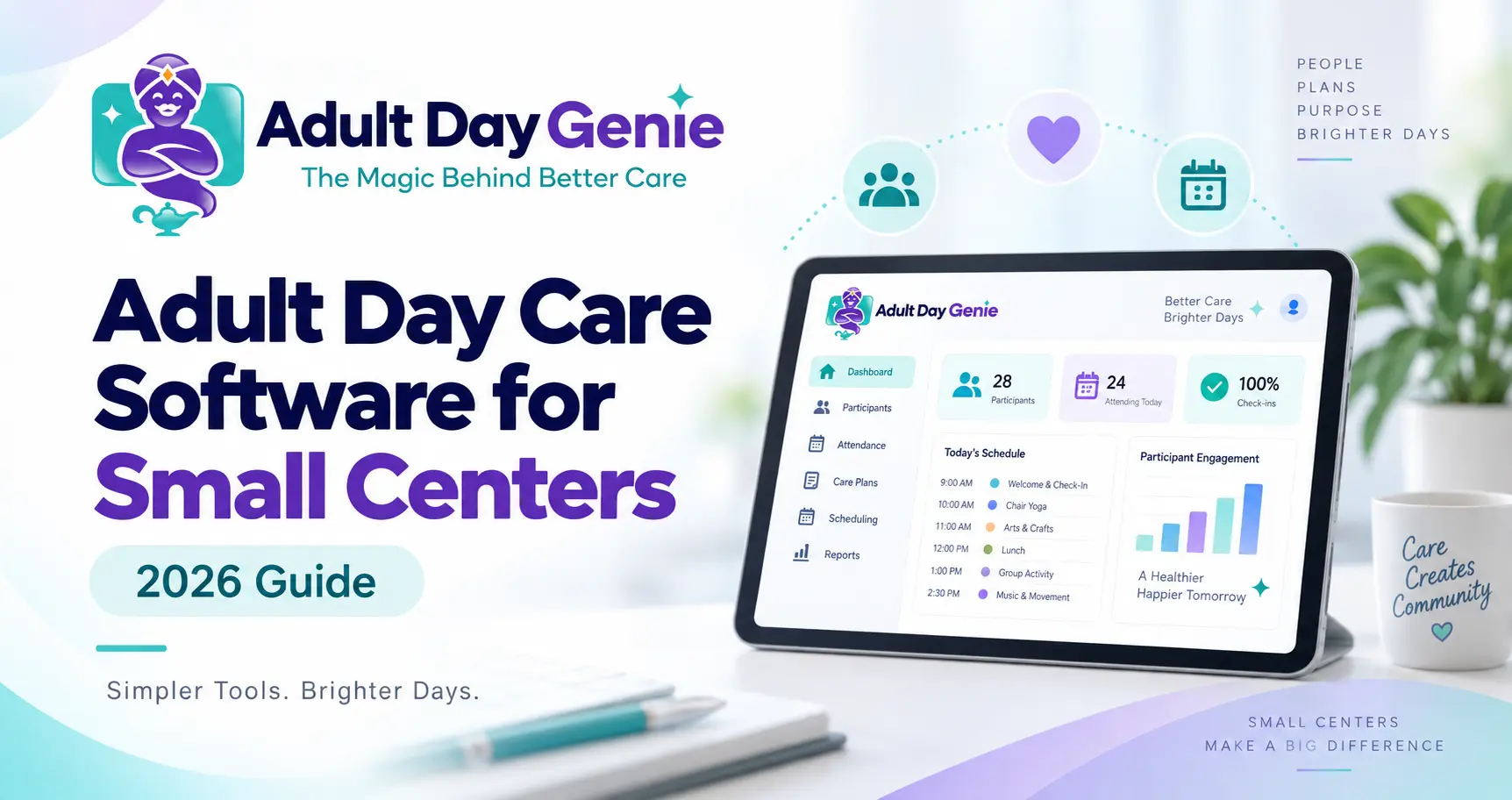
Small adult day centers do not need enterprise software simply because it offers more features. They need software that makes everyday work easier: recording attendance, keeping participant information current, completing documentation, monitoring authorizations, producing reports, and supporting billing when applicable. The right adult day care software for small centers should reduce duplicate work without creating a complicated system that staff struggle to use. A practical rule is simple: choose software around the records your center depends on every day, then add more advanced capabilities only when your census, payer mix, or operating complexity requires them.
What Counts as a Small Adult Day Care Center?
There is no single national regulatory definition of a "small" adult day center, so center size in this guide refers to operational scale rather than a legal classification. The CDC 2025 National Post-acute and Long-term Care Study estimated 4,448 U.S. adult day services centers. Among centers categorized by current enrollment, 25.7% had 1–25 participants and 54.5% had 26–100 participants. In other words, 80.2% fell within the 1–100 participant range. That makes small and mid-sized operations a substantial part of the adult day services market, not an unusual edge case.
Does a Small Adult Day Care Center Need Software?
Not automatically. A center usually reaches the point where software becomes useful when paper, spreadsheets, or disconnected systems begin creating extra work or unreliable records. If the center has only one significant problem, it may make sense to digitize that workflow first rather than buying every available module.
- Attendance is recorded in one place and re-entered somewhere else
- Staff cannot easily tell which participant information is current
- Attendance corrections overwrite the original entry or are difficult to trace
- Authorization dates or units are tracked manually
- Documentation is completed from memory later in the day
- Routine reports require manual spreadsheet work
- Billing staff must reconcile claims against separate attendance records
- Producing records for a payer or reviewer takes too long
For example, purpose-built adult day care attendance software can replace paper check-in while allowing the center to expand later. Adult Day Genie supports manual or consent-based face check-in, time-stamped attendance entries, correction history, member profiles, schedules, and exports.
What Should Adult Day Care Software for Small Centers Handle?
For a smaller center, a handful of reliable workflows usually matter more than a long enterprise feature list. Adult day care management software for small centers should make the most important daily records easier to create, review, and retrieve.
1. Reliable Attendance
Check-in and check-out should be fast enough that staff actually record them when they happen. The system should also make it clear who recorded an entry and how corrections are handled. A correction should not quietly erase the history that came before it.
2. One Current Participant Record
Staff should not need several spreadsheets and folders to answer basic questions about a participant. Depending on the program, one current record may include demographics, contacts, expected attendance, authorizations, care information, consents, and other required documentation. The exact fields vary, but staff should always know which record is current.
3. Practical Daily Documentation
Software should make documentation easier during the day rather than creating another task at closing time. A simple workflow staff consistently use is usually more valuable than an advanced documentation system they avoid.
4. Authorization Visibility
Centers that work with authorized services should be able to see relevant dates, units, or other limits without relying entirely on a manually maintained spreadsheet. The exact authorization requirements depend on the state, payer, program, and contract.
5. Reports and Billing Connections
Managers should be able to answer basic questions without rebuilding the record: Who attended? What was documented? What is missing? What changed? Can the requested records be exported? For centers that bill Medicaid, connecting claims to attendance and documentation can reduce duplicate entry. Adult Day Genie's Medicaid billing workflow connects billing to attendance and supporting records instead of treating claims as a completely separate process.
What Do You Need Now, and What Can Wait?
| Capability | Usually Useful Early | Add When Needed |
|---|---|---|
| Attendance/check-in | Yes | |
| Participant profiles | Yes | |
| Daily documentation | Yes | |
| Reports and exports | Yes | |
| Authorization tracking | Depends on payer model | As complexity grows |
| Activities and meals | When relevant to the program | |
| Family communication | When communication needs grow | |
| Medication/MAR records | If applicable | |
| Medicaid billing | If applicable | |
| Multi-location controls | When multiple locations exist | |
| Complex integrations | When there is a defined business need |
The goal is not to avoid useful features. It is to avoid paying for complexity before the center has a real operational reason for it. Good software for small adult day care centers should let the organization start with the workflows it needs today and expand without forcing a full enterprise setup from day one.
What Changes at 25, 50, and 100 Participants?
These examples are operating scenarios, not licensing, Medicaid, staffing, or regulatory thresholds. They are useful for understanding how software priorities can change as the volume of records, staff activity, and exceptions increases.
Around 25 Participants
Prioritize simplicity. Attendance, current participant information, essential documentation, and easy exports may solve most of the center's immediate problems. A system that requires a specialist administrator may create more work than it removes.
Around 50 Participants
Standardization becomes more valuable. More participants usually mean more records, more staff interactions, and more opportunities for inconsistent documentation. Authorization visibility, standardized forms, staff permissions, and recurring reporting can become more important.
Around 100 Participants
Connected workflows matter more. The question changes from "Can we record this?" to "Can the right staff member find, verify, correct, and export this record without recreating it somewhere else?" At this stage, connected attendance, documentation, authorizations, reporting, and billing may be more valuable than several independent tools.
How to Find Affordable Adult Day Care Software
Affordable adult day care software should be evaluated by total cost, not just the advertised monthly subscription. A platform that costs less each month is not necessarily cheaper if employees still need to enter the same information into multiple systems.
- Monthly subscription
- Setup or implementation fees
- Per-user charges
- Per-participant charges
- Costs as census increases
- Billing or claims fees
- Required add-on modules
- Training and support costs
- Contract length
- Cancellation terms
Adult Day Genie's published pricing currently lists an Attendance plan and a broader Daycare plan designed around center-based workflows. Check the live pricing page for current plan limits, billing add-ons, and any charges that apply as enrollment grows rather than relying on an older article or quote.
What About Medicaid Billing and EVV?
If your center bills Medicaid, ask where the billed service date comes from and whether staff can trace it back to the supporting attendance and documentation. Exact billing and documentation requirements vary by state, payer, program, and contract, so software should help organize and validate records rather than promise that a claim will be approved.
EVV also needs to be understood correctly. CMS Electronic Visit Verification guidance states that the federal EVV requirement applies to specified Medicaid personal care services and home health care services that require an in-home visit by a provider. That does not automatically make ordinary center-based adult day services subject to the federal EVV mandate. State, payer, or program-specific attendance and verification requirements may still apply.
What Is the Best Adult Day Care Software for Small Centers?
The best adult day care software for small centers is not necessarily the cheapest platform or the product with the longest feature list. A better test is whether the software fits the center's real daily workflow and remains understandable as the organization grows.
- Can front-line staff learn the daily workflow quickly?
- Can corrections be made without erasing the original record?
- Can records be exported easily when requested?
- Is pricing understandable at today's census and as the center grows?
- Does the system connect workflows staff currently repeat manually?
If you need a broader vendor-selection process, use the complete adult day care software buyer's guide instead of trying to evaluate every vendor feature inside this small-center guide.
Small-Center Software Decision Checklist
Software is worth a closer look when several of the following statements are true:
- We enter the same information more than once
- Attendance corrections are difficult to trace
- Important participant information lives in several places
- Staff spend too much time completing records after the day ends
- Authorization tracking depends on manual reminders
- Reports require spreadsheet reconciliation
- Billing information comes from a different record than attendance
- Producing requested documentation takes too long
- Our current process becomes harder as enrollment grows
If only one problem exists, solve that problem first. A smaller center does not have to replace every workflow at once.
Bottom Line
Adult day care software for small centers should make the daily record simpler, not turn a small organization into an enterprise IT department. Start with the workflows your team uses every day. Add advanced features when they solve a real operational, payer, or documentation problem. Adult Day Genie lets centers start with attendance or use the broader platform for participant records, daily operations, reporting, family communication, and Medicaid billing around the same participant record.
Want to see whether Adult Day Genie fits a center your size? Bring your current participant count and workflow. See how Adult Day Genie fits your center and review how check-in, participant records, documentation, reporting, and billing can work together for your operation.
Frequently Asked Questions
Does a small adult day care center need software?
Not necessarily. Software becomes useful when paper or spreadsheets cause duplicate entry, unclear corrections, difficult reporting, authorization problems, or billing reconciliation. A very small center can start by digitizing one important workflow and expand later.
What features are most important for a small adult day center?
Start with reliable attendance, participant records, daily documentation, useful reports, and authorization tracking when applicable. Billing, medication records, family communication, and other modules should be added based on the center's actual services and payer requirements.
Can a small adult day center keep using spreadsheets?
Yes, if spreadsheets still provide accurate, secure, current, and manageable records. They become less practical when multiple staff edit them, information is duplicated, corrections are difficult to trace, or data must be reconciled with documentation and billing.
Does adult day care software need EVV?
Federal EVV requirements apply to specified Medicaid personal care and home health services requiring an in-home visit. Center-based adult day services are not automatically subject to that federal mandate, although state, payer, program, or contractual verification requirements may still apply.