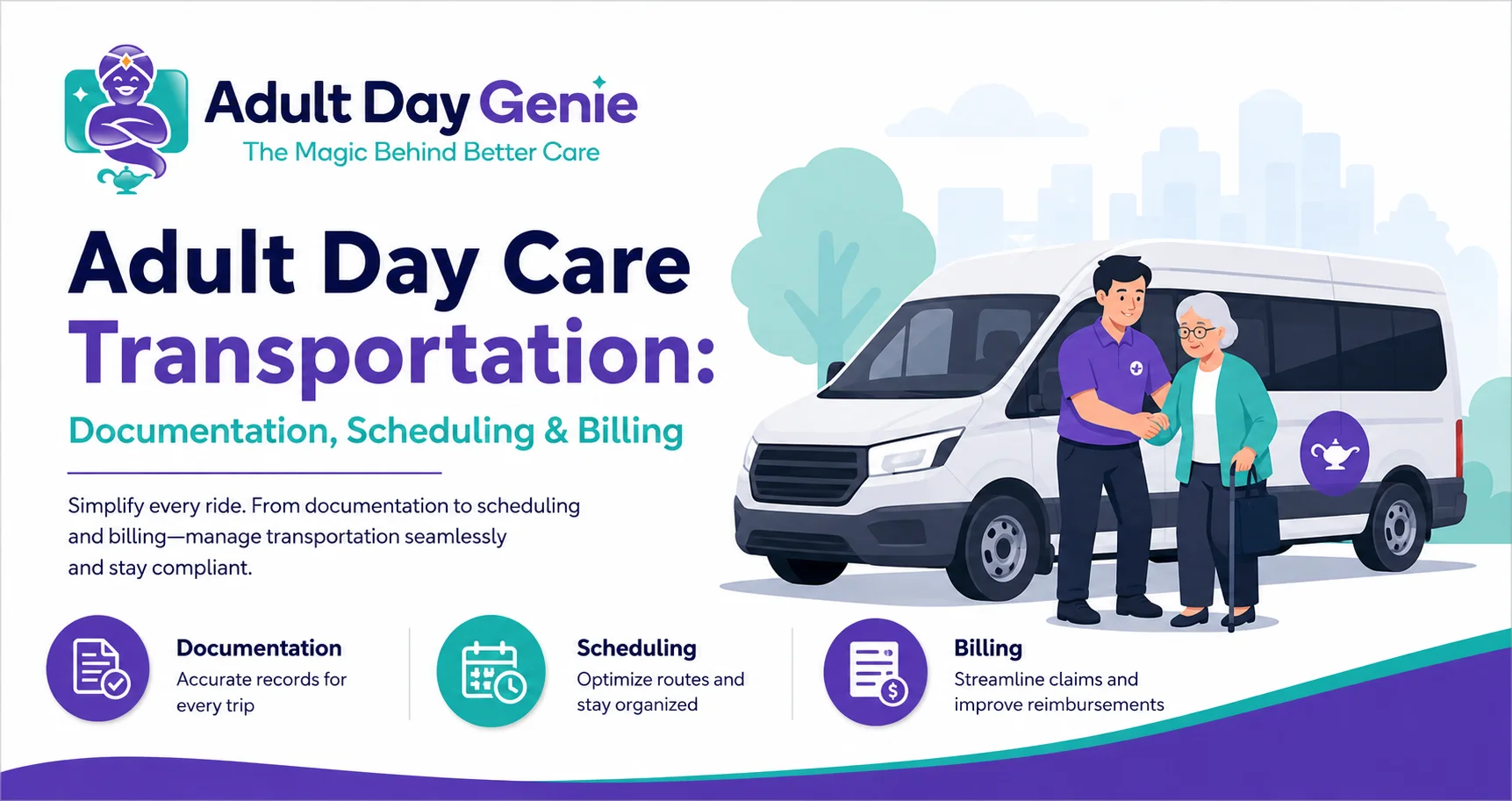
Transportation may look like a simple scheduling task, but for an adult day center it can affect compliance, attendance records, participant safety, and billing. Adult day care transportation requirements vary by state, payer, program, and the way transportation is provided. Centers that provide or arrange rides should determine which rules apply, document what actually happened on each trip, reconcile transportation with attendance, and retain records needed to support any transportation-related billing. The goal is simple: your transportation schedule, completed-trip documentation, attendance record, and billing record should tell a consistent story.
This guide provides general operational information, not legal or billing advice. Always verify current requirements with your state licensing agency, Medicaid program, payer contracts, and transportation agreements.
Are Adult Day Care Centers Required to Provide Transportation?
Not always. There is no single nationwide rule requiring every adult day care center to provide transportation. Requirements differ by state, program, payer, and service model. For example, Georgia's adult day center regulations classify transportation as an optional service. However, when a center provides transportation, requirements can apply to vehicles, insurance, drivers, safety, and participant transportation arrangements. The important distinction is that transportation may be optional while still creating compliance responsibilities when a center chooses to provide it.
- Determine whether transportation is required, optional, or arranged through another provider
- Verify which driver, insurance, vehicle, and safety requirements apply
- Confirm who is responsible for providing or arranging each participant's transportation
- Identify what transportation documentation must be retained
- Verify whether transportation is separately reimbursable or included in another service
What Adult Day Care Transportation Documentation Should You Keep?
Good adult day care transportation documentation should separate what was planned from what actually occurred. A participant may normally be scheduled for transportation every Monday, Wednesday, and Friday, but that recurring schedule does not prove that a ride occurred on a particular date. The completed record should document the actual transportation event. Transportation records should also fit into your broader adult day care documentation requirements so the participant's service-day history remains consistent.
- Participant name or identifier
- Date of service
- Pickup or drop-off direction
- Actual transportation time
- Driver, provider, vehicle, or route where required
- Completed, cancelled, or no-show status
- Relevant transportation exceptions or changes
- Required signatures, attestations, or supporting evidence
The exact fields depend on your state, Medicaid program, payer contract, and transportation arrangement. A generic template should therefore be treated as an operational starting point, not a substitute for the rules that apply to your center.
What Should an Adult Day Care Transportation Log Include?
An adult day care transportation log should make one basic question easy to answer later: What transportation actually occurred for this participant on this service date? A reviewer should be able to move from the transportation record to the participant and date without relying on staff memory or reconstructing the day from several disconnected documents.
| Field | What It Shows |
|---|---|
| Participant | Who received transportation |
| Service date | When the trip occurred |
| Trip direction | Pickup, drop-off, or round trip |
| Actual time | When transportation occurred |
| Driver/provider | Who provided the ride where required |
| Trip status | Completed, cancelled, no-show, or exception |
| Notes | Relevant schedule changes or unusual events |
| Verification | Signature or other evidence where required |
North Carolina's FY2026 adult day monitoring process shows why this evidence matters. Reviewers may use documentation such as driver logs, vendor pickup and drop-off records, or itemized transportation bills and compare transportation units with participant attendance. That makes the completed transportation record more important than the schedule alone.
Adult Day Care Transportation Scheduling: Planned vs. Actual
Adult day care transportation scheduling is often repetitive. Participants may attend on the same days each week and use similar pickup arrangements. Recurring schedules are useful for planning, but centers should keep the planned schedule separate from the completed-trip record.
- Recurring schedule — shows the participant's normal transportation days, location, and assistance needs
- Daily transportation list — shows who is expected to ride after known absences and temporary changes are considered
- Completed trip record — shows what actually happened, including completed rides, cancellations, no-shows, and exceptions
A useful operating rule is: scheduled transportation is not proof of completed transportation. The same principle applies to attendance. A participant who was expected to attend is not automatically a participant who actually received the service.
Transportation and Attendance Should Tell the Same Story
Transportation and attendance records do not need identical timestamps because pickup from a participant's home happens before arrival at the center. They should, however, make sense together. If transportation records show that a participant was delivered to the center, there should normally be a corresponding attendance record or a documented reason why the expected service did not occur.
- Transportation no-shows should not remain recorded as completed trips
- Cancellations should be reflected consistently
- Early departures should be documented
- Unexpected schedule changes should reach the final daily record
- Corrections should not create conflicting transportation and attendance histories
This is why a reliable adult day care attendance tracking process is an important part of transportation documentation. Transportation, attendance, and service records should be reconciled before staff have to reconstruct events weeks later.
Adult Day Care Transportation Billing: What Should Be Verified?
Adult day care transportation billing varies significantly between programs. Transportation may be separately reimbursable, included within another service rate, handled through a Medicaid waiver or managed care arrangement, provided by another organization, or not separately billable. Do not assume that a transportation code, unit, or billing method used in one state applies nationally.
- Was the participant eligible or authorized for the transportation service?
- Did the transportation actually occur?
- Does the completed-trip documentation support the service?
- Does the transportation record reconcile with attendance or other service documentation?
- Are the correct units and payer-specific billing rules being applied?
- Is transportation already included in another reimbursed service?
The safest approach is to connect transportation evidence with the records used for Medicaid billing for adult day centers, rather than discovering missing trip or attendance documentation only when claims are being prepared.
A Simple Transportation Review Before Billing
Before closing a service day or using transportation records to support billing, perform a short reconciliation. Small discrepancies are much easier to resolve on the day they happen than several weeks later.
- Confirm the correct participant and service date
- Reconcile scheduled transportation with what actually occurred
- Check required pickup and drop-off evidence
- Document cancellations and no-shows
- Confirm transportation and attendance records are consistent
- Verify required authorization and payer rules
- Preserve a clear history when records are corrected
How Adult Day Genie Fits Into the Workflow
Transportation software and adult day care management software solve different problems. Centers operating complex fleets may need dedicated tools for GPS tracking, dispatch, routing, or vehicle management. Adult Day Genie focuses on the center's daily operational record: attendance, participant information, care documentation, authorizations, reporting, and Medicaid claim preparation.
That matters because transportation should not become an isolated spreadsheet or paper record that billing staff have to reconcile later. The goal is a clearer evidence chain: transportation → attendance → documentation → billing. For centers replacing disconnected records and manual processes, the right adult day care software can make it easier to understand what happened for a participant on a particular service date.
Frequently Asked Questions
Are adult day care centers required to provide transportation?
Not in every state or program. Transportation may be required, optional, arranged through another provider, or subject to additional requirements when the center chooses to provide it. Always verify the rules for your specific state and program.
What should an adult day care transportation log include?
Requirements vary, but a useful transportation log generally identifies the participant, service date, pickup or drop-off event, actual time, trip status, applicable driver or provider information, exceptions, and any verification required by the governing program.
What is adult day care transportation documentation?
Adult day care transportation documentation is the record showing how transportation was planned and what actually occurred. It may include schedules, manifests, driver logs, pickup and drop-off records, exception notes, authorizations, and contractor records.
How should adult day care transportation scheduling connect with attendance?
Scheduling shows what was expected, while completed transportation and attendance records show what actually happened. Centers should reconcile the records so cancellations, no-shows, late arrivals, and other changes do not create conflicting service histories.
How does adult day care transportation documentation affect billing?
When transportation is separately billable, documentation should support that the trip occurred and that applicable authorization, attendance, service-unit, and payer requirements were satisfied.
Adult day care transportation requirements are easier to manage when transportation is treated as part of the participant's complete service-day record rather than an isolated schedule. Document what actually happened, reconcile it with attendance, verify payer requirements before billing, and maintain a clear correction history. Adult Day Genie helps adult day centers connect attendance, participant documentation, and 837P claim preparation in one daily workflow. See Adult Day Genie in 15 minutes to see how your center can build a clearer operational record.