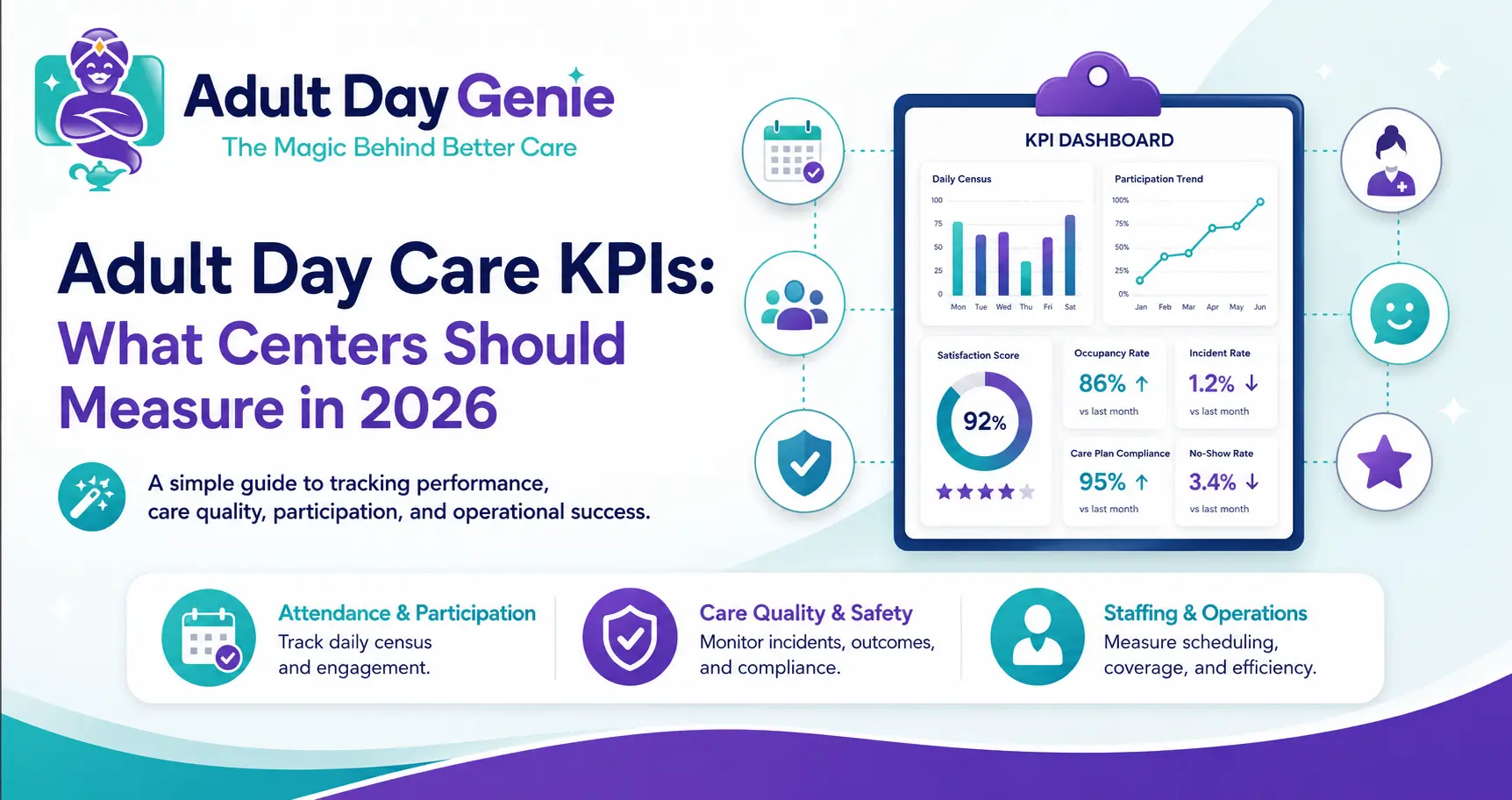
Adult day centers already collect a large amount of operational data: attendance, enrollment, staff schedules, care-plan reviews, activities, incidents, family communication, authorizations, and billing records. The problem is that collecting data is not the same as using it. A useful KPI should help a director see a trend, ask a better question, and decide what needs attention.
This guide explains practical adult day care KPIs centers can use to monitor operations and connect everyday records to a clearer picture of performance. It also separates operational metrics from participant and caregiver outcomes, because a busy center is not automatically an effective center—and one number rarely proves quality by itself.
What Are the Most Important Adult Day Care KPIs?
The most useful adult day care KPIs generally cover attendance and utilization, participant retention, staffing, safety trends, engagement, documentation completion, family experience, authorization or billing readiness, and participant outcomes. The right scorecard is small enough to review consistently and specific enough to trigger action when a trend changes.
There is no single nationwide KPI target that every adult day center should meet. Center capacity, service model, population, state requirements, payer contracts, staffing model, and operating schedule all affect what a healthy number looks like. Start with a consistent baseline, compare like periods, and investigate meaningful changes instead of copying another center's target.
KPI vs. Outcome Measure: Know the Difference
| Measure Type | Main Question | Example |
|---|---|---|
| Operational KPI | How is the center performing? | Average daily attendance |
| Process KPI | Are required or planned tasks being completed? | Care-plan reviews completed on time |
| Safety KPI | Are risk patterns changing? | Incidents per 100 participant-days |
| Experience measure | What are participants or families experiencing? | Family satisfaction or communication feedback |
| Outcome measure | What changed for participants or caregivers? | Engagement, belonging, caregiver well-being, or another appropriate outcome |
This distinction matters. A center can have strong attendance and still need to improve engagement. It can have few recorded incidents without knowing whether reporting is consistent. And a high documentation-completion rate shows process reliability, not necessarily improved participant well-being.
Adult Day Center KPIs: A Practical Performance Scorecard
| KPI | Simple Calculation | What It Can Tell You | What to Investigate |
|---|---|---|---|
| Average Daily Attendance | Total participant-days ÷ operating days | Typical daily census and workload | Sudden changes, scheduling patterns, referral flow |
| Capacity Utilization | Participant-days ÷ available capacity-days × 100 | How much defined operating capacity is being used | Underused days, scheduling constraints, demand |
| Cohort Retention Rate | Starting participants still enrolled at period end ÷ starting cohort × 100 | Continuity over a defined period | Discharge reasons, transportation, satisfaction, health changes |
| Unscheduled Absence Rate | Unscheduled absences ÷ scheduled attendance opportunities × 100 | Reliability of scheduled attendance | Transportation, illness, caregiver issues, scheduling |
| On-Time Review Rate | Reviews completed by due date ÷ reviews due × 100 | Process reliability | Workload, reminders, ownership |
| Documentation Completion Rate | Required records completed by cutoff ÷ records due × 100 | Whether records are keeping pace with service delivery | Workflow bottlenecks, training, unclear responsibility |
| Incident Rate | Reported incidents ÷ participant-days × a consistent base | Safety trend over time | Event type, location, time, repeat patterns |
| Activity Engagement Rate | Recorded participations ÷ defined eligible opportunities × 100 | Whether programming is reaching participants | Activity fit, timing, preferences, accessibility |
| Authorization Utilization | Units used ÷ authorized units × 100 | Pace of authorized service use | Underuse, overuse risk, scheduling, upcoming limits |
These formulas are management tools, not universal regulatory standards. Define the denominator the same way each reporting period so the trend remains meaningful. If your team changes the definition halfway through the year, the comparison may stop being useful.
Average Daily Attendance and Utilization
Average Daily Attendance, often shortened to ADA, is one of the most useful adult day care metrics because so many other operational decisions depend on how many participants are actually present.
A simple formula is: Average Daily Attendance = Total participant attendance days ÷ Number of operating days. If a center records 440 participant-days across 20 operating days, its ADA for that period is 22.
ADA becomes more useful when viewed as a trend rather than an isolated number. Compare similar months, days of the week, program schedules, transportation patterns, and referral changes. A drop does not automatically mean participants are dissatisfied; transportation interruptions, illness, holidays, authorization changes, or scheduling patterns may be contributing.
The quality of this KPI depends on the underlying attendance record. Adult Day Genie's adult day care attendance sheet template explains the service-day fields that help make attendance data reliable enough to analyze later.
Participant Retention: Measure It, Then Ask Why
Retention tracks how many participants from a defined starting group remain enrolled at the end of a period.
For a simple cohort measure: Retention Rate = Participants from the starting cohort still enrolled at period end ÷ Participants in the starting cohort × 100.
Do not treat every discharge as a failure. A participant may leave because of hospitalization, relocation, a change in level of care, payer eligibility, family circumstances, transportation barriers, or another reason outside the center's control.
The KPI should therefore lead to a second question: Why are participants leaving? Consistently categorizing discharge reasons can turn a basic retention percentage into a useful management signal.
Staffing Performance: Measure Coverage, Not Just Headcount
A staffing KPI should help management compare actual participant presence with the staffing coverage needed for that service day. The useful question is not simply how many employees are on payroll—it is whether appropriately qualified staff coverage matched participant needs and applicable requirements when services were delivered.
Because staffing ratios and qualifications vary by jurisdiction and program type, avoid creating one national staffing target inside the KPI dashboard. Compare actual staffing against the requirement and operating plan that apply to your center.
For the underlying compliance rules, qualifications, schedules, ratios, and staff records, use Adult Day Genie's adult day care staffing requirements guide rather than trying to reproduce those rules inside a performance dashboard.
Incident Rate: A Low Number Is Not Automatically a Good Number
Incident trends can help a center identify recurring safety problems, but raw incident counts can be misleading. A center serving more participant-days naturally has more exposure to possible events, so a normalized internal rate may be more useful for trend analysis.
For example: Incident Rate = Reported incidents ÷ Participant-days × 100. The multiplier can be changed, but use the same one consistently.
More importantly, do not assume a lower incident rate automatically proves better safety. A falling number can reflect genuine improvement, but it can also reflect inconsistent reporting. Review the rate alongside incident types, severity, locations, repeat events, and staff reporting practices before drawing conclusions.
Activity Engagement: Go Beyond Counting Activities Offered
A calendar showing 20 activities does not tell management whether participants found them meaningful. Engagement measurement asks whether the people for whom an activity was appropriate actually participated and whether patterns change across activities, times, or participant groups.
A center can define an internal activity engagement rate using a consistent denominator such as eligible participation opportunities. The important part is defining what counts as an opportunity before comparing periods.
Recent adult day services research has pushed the industry beyond simple participation counts. Person-centered outcome research has identified domains such as meaning and purpose, engagement, social networks, and sense of belonging as areas adult day services may consider when evaluating participant experience.
Care Plan and Documentation Completion Metrics
Some of the most actionable adult day care performance metrics are process measures because management can directly change the workflow behind them.
- Percentage of care-plan reviews completed by the required or planned due date
- Percentage of assessments or reassessments completed by the applicable deadline
- Percentage of required service-day records completed before a defined cutoff
- Number of incomplete records requiring follow-up
- Number of corrections or missing fields identified during internal review
A high completion rate does not guarantee that the documentation is clinically or operationally meaningful. It tells you the process is being completed. Quality still requires reviewing whether the record is accurate, participant-specific, and consistent with the services actually delivered.
Adult Day Genie's adult day care documentation requirements guide covers the underlying participant and operational records. Use the KPI dashboard to measure whether those records are being completed and kept current—not to redefine what each record should contain.
Family and Caregiver Experience Metrics
Family experience is harder to summarize than attendance because communication quality is not captured by one universal percentage. Centers should measure only what they can define consistently.
- Planned family updates completed
- Response time to non-urgent family questions, if the center tracks it
- Satisfaction survey results using the same questions over time
- Repeated communication concerns
- Reasons families give when attendance patterns or enrollment change
Do not equate the number of messages sent with family satisfaction. Communication volume is a process measure; family trust, clarity, and experience are different outcomes.
For the actual communication workflow—what to share, when to update families, when to call, and how to handle privacy—see Adult Day Genie's adult day care family communication guide.
Billing and Authorization Metrics
Operational leaders should also monitor whether scheduled and delivered services are staying aligned with available authorizations and the documentation needed for billing.
- Authorization utilization by participant
- Units remaining as the authorization period progresses
- Services waiting for documentation before billing
- Claims requiring correction or review
- Denials categorized by reason where reliable data is available
- Time between service completion and claim readiness
These measures are useful because they connect operations with revenue without treating billing as a separate back-office problem. A center may have strong attendance while still creating avoidable billing delays if authorizations, service documentation, and claims are not aligned.
Adult Day Genie's adult day care Medicaid billing software guide covers that workflow in depth; the KPI article should only use billing data as a management signal.
Adult Day Care Outcome Measures: Go Beyond Operational Performance
Operational KPIs answer whether the center is running consistently. Adult day care outcome measures ask a different question: what is happening for participants and caregivers?
Adult day services research has long identified the need for more consistent outcome measurement. Research on integrated participant assessment has examined physical, mental, and cognitive health indicators along with activity engagement, while newer person-centered research is evaluating practical measures related to meaning, friendship, belonging, and engagement.
| Outcome Domain | What a Center May Want to Understand | Important Caution |
|---|---|---|
| Participant engagement | Whether participants are meaningfully involved | Participation count alone may not measure quality |
| Belonging and social connection | Whether participants feel socially connected | Use an appropriate, consistent measure |
| Meaning and purpose | Whether programming supports personally meaningful experience | Avoid inventing an unvalidated score |
| Functional or cognitive status | Whether relevant abilities change over time | Changes may reflect many factors beyond the center |
| Caregiver experience | Whether services support the caregiver relationship and burden | Requires caregiver-specific measurement |
| Healthcare utilization | Hospital, emergency, or institutional-care patterns where valid data is available | Do not claim causation without appropriate evidence |
Why Outcome Tracking Matters More in 2026
This is becoming an industry-level issue, not just an internal management exercise.
A new five-year adult day services research agenda for 2026–2031, published in August 2026, was developed with adult day services stakeholders in partnership with the National Adult Day Services Association. The top priority identified was stronger data infrastructure. Stakeholders highlighted the need for better data to understand workforce shortages, support evidence-based interventions, inform policymakers, address uneven reimbursement, and improve standardized outcome measurement.
LeadingAge's 2026 adult day advocacy goals point in the same direction. Its policy platform calls for a framework of metrics that can help demonstrate adult day's value in areas such as hospitalization prevention, caregiver support, quality of life, and delayed institutional placement.
That does not mean an individual center should claim it prevented a hospitalization simply because someone attended the program. It means the industry is moving toward a stronger expectation that providers collect consistent information and participate in better measurement of value.
Build a Monthly Adult Day Center Scorecard
Start smaller than you think. A dashboard with 30 numbers that no one reviews is less useful than eight metrics leadership discusses every month.
- Select 6–10 measures tied to actual management decisions.
- Write down the exact definition and formula for each KPI.
- Identify the system or record that supplies the data.
- Assign one person responsible for reviewing each measure.
- Compare the current period with a meaningful prior period or baseline.
- Flag changes that require investigation rather than automatically labeling them good or bad.
- Assign an action when a trend needs attention.
- Review the metric again after the intervention.
- Retire metrics that no longer inform a decision.
- Add outcome measures only when your team can collect them consistently and appropriately.
A useful management loop is: Measure → Compare → Investigate → Act → Recheck. The KPI is the signal. The management decision is the value.
Common Adult Day Care KPI Mistakes
- Tracking too many metrics at once
- Measuring what is easy instead of what is useful
- Changing formulas between reporting periods
- Comparing different populations or operating periods without context
- Treating a high attendance number as proof of care quality
- Treating a low incident count as proof of safety
- Tracking percentages without reviewing the underlying records
- Using arbitrary national benchmarks that do not apply to the center
- Confusing process completion with participant outcomes
- Claiming the center caused an outcome when the data only shows an association
- Creating dashboards without assigning anyone to act on the findings
Good KPIs Depend on Good Source Data
A dashboard cannot repair unreliable source records. If attendance is incomplete, discharge reasons are inconsistent, care-plan reviews are not dated clearly, or billing status is maintained in separate spreadsheets, the resulting KPI may look precise while still being wrong.
That is why the first question behind every KPI should be: Where does this number come from, and can we reproduce it next month using the same definition?
Adult Day Genie connects attendance, participant records, care plans, forms, activities, meals, daily documentation, reports, authorizations, and Medicaid billing within the center's operational workflow. Explore Adult Day Genie software features if your team currently has to assemble management information from separate spreadsheets, paper records, and disconnected systems.
Final Takeaway
The best adult day care KPIs are not the ones that create the largest dashboard. They are the measures that help leadership understand what is changing, investigate why it is changing, and decide what to do next.
Start with reliable operational measures such as attendance, utilization, retention, documentation completion, staffing coverage, incidents, engagement, and authorization or billing readiness. Then add carefully selected participant and caregiver outcome measures as your center develops the ability to collect them consistently.
If your team already records the information but spends hours assembling it when leadership, a payer, or a reviewer asks for answers, bring your current workflow to a 15-minute Adult Day Genie walkthrough and see how the underlying records can stay connected.
Frequently Asked Questions
What KPIs should an adult day center track?
Useful adult day center KPIs commonly include average daily attendance, capacity utilization, participant retention, staffing coverage, incidents, activity engagement, care-plan or documentation completion, authorization utilization, billing readiness, family experience, and selected participant outcomes.
How do you calculate average daily attendance in adult day care?
Divide total participant attendance days during the reporting period by the number of days the center operated. Use the same definition each period so the trend remains comparable.
What is the difference between an adult day care KPI and an outcome measure?
A KPI measures operational or process performance, such as attendance or on-time reviews. An outcome measure evaluates what changes or is experienced by participants or caregivers, such as engagement, belonging, well-being, or healthcare utilization.
What is a good adult day care utilization rate?
There is no universal utilization percentage that defines a good adult day center. Capacity, service model, demand, operating schedule, payer mix, and staffing constraints differ. Centers should use consistent internal definitions and compare trends against their own goals and applicable requirements.
How often should adult day care KPIs be reviewed?
Many operational metrics are useful on a monthly scorecard, while some measures need daily or weekly monitoring and longer-term outcomes may be reviewed less frequently. The review schedule should match how quickly management can reasonably act on the information.
How can adult day centers measure outcomes?
Centers can combine consistent operational data with appropriate participant and caregiver outcome measures. Depending on the objective, this may include engagement, social connection, meaning or purpose, caregiver experience, functional indicators, or healthcare utilization. Use validated measures when appropriate and avoid claiming causation that the data cannot support.