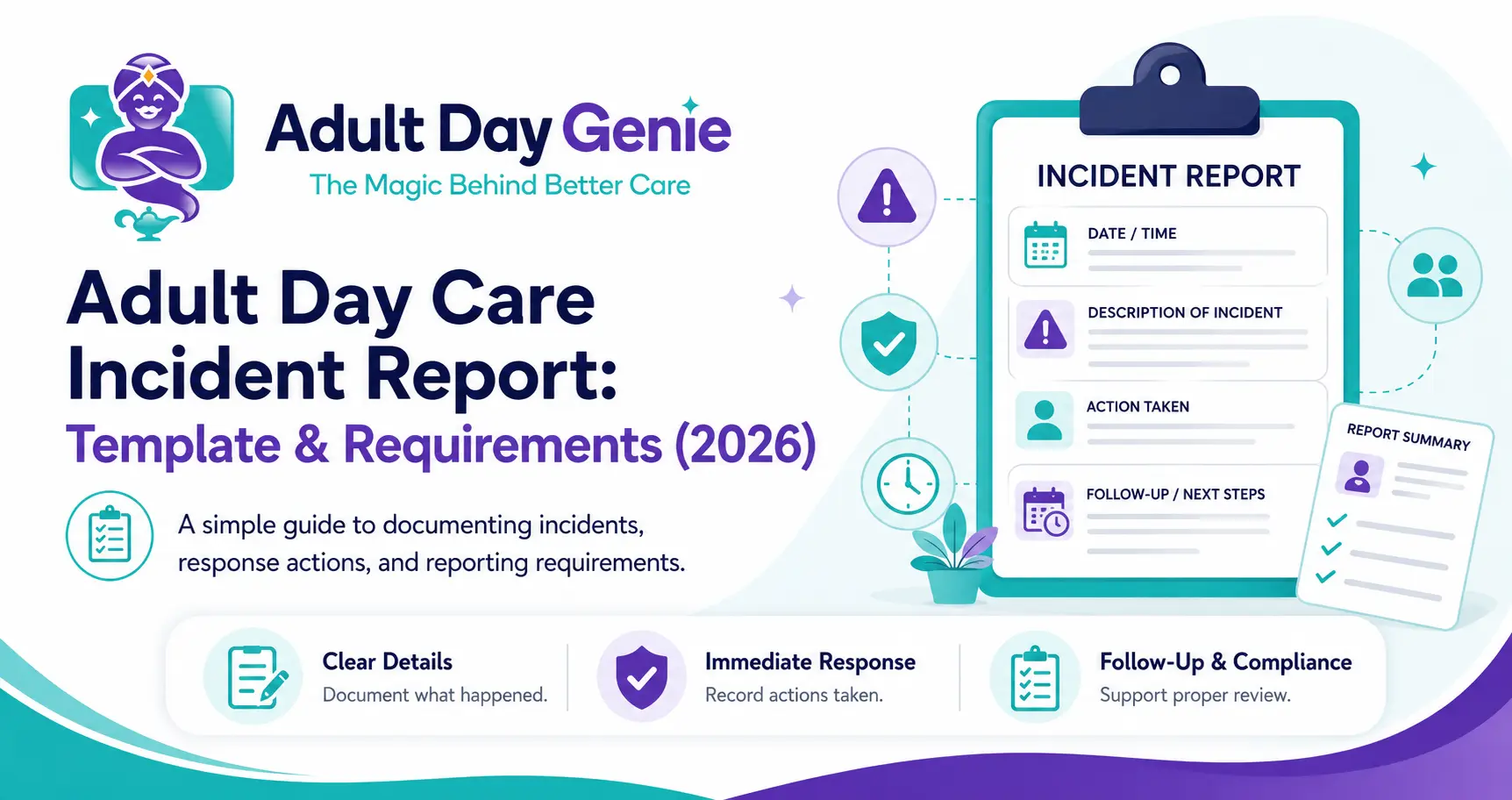
An incident report should give an adult day center a clear, factual record of what happened, what staff observed, what actions were taken, who was notified, and what follow-up is still required. The goal is not to assign blame. It is to preserve an accurate record while details are fresh and support the center's next safety and reporting steps.
This adult day care incident report guide provides a practical U.S. framework. It is not a universal legal form. What counts as a reportable incident, who must be notified, and how quickly a report must be submitted can vary by state, Medicaid program, payer, service model, and incident type.
Adult Day Care Incident Report: Quick Answer
An adult day care incident report should document who was involved, when and where the event happened, what was observed, the participant's condition, immediate actions, notifications, witnesses, outcome, and follow-up. External reporting requirements and deadlines vary by state and program, so centers should verify the rules that apply to each event.
Adult Day Care Incident Report Template
Use these fields as a practical starting point for an adult day care incident report template. Modify them to match the requirements governing your center.
| Report Field | What to Document | Why It Matters |
|---|---|---|
| Participant or person involved | Correct name and applicable identifying information | Connects the event to the correct record |
| Date and time | When the incident occurred and, if different, when staff became aware | Establishes chronology and may affect reporting deadlines |
| Location | Where the event occurred | Adds context to the incident |
| People present | Staff, participants, visitors, or others directly involved | Identifies possible information sources |
| Objective description | What staff saw, heard, or were told, without unsupported conclusions | Creates a factual record |
| Participant condition | Observable injury, symptoms, distress, or condition when applicable | Supports response and follow-up |
| Immediate actions | First aid, supervision, emergency response, or other steps taken | Documents the center's immediate response |
| Notifications | Representative, supervisor, regulator, payer, protective services, law enforcement, or others when required | Shows who was informed and when |
| Witnesses | Relevant witness names or statements according to policy | Supports review or investigation |
| Outcome and follow-up | Disposition, unresolved actions, monitoring, or additional review | Keeps the incident from ending with the form |
| Reporter and reviewer | Who prepared and reviewed the report, with dates or signatures where required | Supports traceability and accountability |
A useful adult day care incident report form should also make incomplete items obvious. Fields such as Not Applicable, Pending, and Follow-Up Required are more informative than unexplained blanks.
Incident Report vs. Reportable Incident: What Is the Difference?
An internal incident report and an externally reportable incident are related, but they are not automatically the same thing. A center may document an event internally even when it does not meet an external reporting threshold. Other events trigger specific notification duties under state or program rules.
| Record or Action | Main Purpose | Key Point |
|---|---|---|
| Internal incident record | Documents what happened and the center's response | Retained according to applicable policy and recordkeeping requirements |
| External incident report | Notifies an outside authority when required | Triggered by specific rules and reporting deadlines |
| Investigation or follow-up record | Documents findings, corrective action, or prevention steps | May be required for certain serious or unusual events |
Completing an internal form does not by itself prove that every required external notification was made. Your incident workflow should therefore track both documentation and reportability.
Which Adult Day Care Incidents May Be Reportable?
Adult day care reportable incidents are defined by the authority governing the center, not by one nationwide list. Depending on the jurisdiction or program, categories may include serious injury, death, abuse or neglect allegations, exploitation, missing participants, law-enforcement involvement, major emergencies, or other events that threaten participant health, safety, or welfare.
Georgia provides one state-specific example. Its adult day center reporting requirements address serious or unusual incidents including participant death, rape, serious injury requiring medical attention, suspected abuse, neglect or exploitation, and certain missing-participant events. These are Georgia-specific rules and should not automatically be applied to another jurisdiction.
A practical reporting matrix should answer four questions: What events are reportable? Who receives the report? What is the deadline? What documentation must be retained?
What Is an Adult Day Care Unusual Incident Report?
An adult day care unusual incident report is terminology used in some jurisdictions for events that require special documentation or notification beyond routine service records. Pennsylvania, for example, provides an Unusual Incident Report Form and related instructions for adult day centers.
Terminology varies. Another jurisdiction may use phrases such as major incident, serious incident, critical incident, or reportable event. Do not assume that the label or reporting threshold used in one state has the same meaning in another.
Adult Day Care Incident Reporting Requirements: How Fast Must You Report?
There is no single nationwide adult day care incident-reporting deadline. The timeline depends on the incident type and the authority governing the center.
| Example Jurisdiction | Example Timing | Important Limitation |
|---|---|---|
| Virginia licensed adult day centers | Certain major incidents: report within 24 hours; written report within seven days | Virginia-specific requirements |
| Georgia adult day centers | Specified serious or unusual incidents: report no later than the next business day; covered incidents may also require an internal investigation report within five business days | Georgia-specific requirements |
| Your center | Verify the deadline for the specific incident and governing authority | Never rely on another state's timeline |
The Virginia adult day center incident-reporting rule identifies required information and timelines for covered major incidents. Georgia separately establishes reporting and follow-up requirements for specified serious or unusual incidents.
These differences are why adult day care incident reporting requirements should be built into the center's workflow instead of relying on staff to remember a generic deadline after an event occurs.
How to Write an Objective Incident Description
An incident description should record observable facts and clearly attributed statements rather than unsupported conclusions.
- Date, time, and location
- What happened in chronological order
- What staff directly observed
- The participant's observable condition
- Who was present
- Actions staff took
- Relevant statements attributed to the person who made them
- Who was notified and when
- What happened next
Avoid vague wording such as participant acted badly or staff was careless. Describe the behavior, event, or action that was actually observed. Objective documentation is more useful to supervisors, reviewers, investigators, and other appropriate readers than conclusions the writer cannot support.
What Happens After the Incident Report Is Written?
A serious incident workflow should not end when the form is saved. Depending on the event and applicable rules, the center may need to investigate, identify contributing factors, take corrective action, review the participant's assessment or care plan, communicate with appropriate parties, and document closure.
Georgia's adult day center rules provide one state-specific example: covered serious or unusual incidents require an internal investigation documenting the circumstances, findings, corrective action, and steps intended to help prevent recurrence.
- Confirm immediate participant safety and any required medical response.
- Complete the factual incident record.
- Make required notifications within the applicable deadline.
- Preserve relevant witness or supporting information.
- Complete any required review or investigation.
- Assign corrective, preventive, or participant-specific follow-up.
- Determine whether assessment, care plan, staffing, environment, or procedure review is needed.
- Document closure.
Incident Report vs. Progress Note
An incident report documents an unusual or significant event and the response to it. A progress or service note documents relevant services, observations, participant response, changes, and follow-up during the service day.
The same event can affect both records, but the documents should not simply be copied into each other. Your center's broader adult day care documentation requirements should determine how records fit together. For deeper routine service-documentation guidance, use Adult Day Genie's adult day care progress note template.
Common Adult Day Care Incident Reporting Mistakes
- Waiting too long and relying on memory
- Recording conclusions instead of observable facts
- Omitting the exact time or location
- Failing to document who was notified and when
- Treating an internal report as proof that external reporting was completed
- Using another state's deadline without verifying local requirements
- Missing required investigation or corrective-action steps
- Failing to assign ownership for follow-up
- Allowing the report to become disconnected from relevant participant records
Keep Incident Records Connected to the Participant Workflow
An incident report is more useful when appropriate staff can understand it in the context of the participant's current record. A significant event may lead the center to determine whether an assessment, care plan, or other participant record needs review.
That does not mean every incident automatically requires a care-plan change. It means the center should have a reliable process for deciding whether review is needed under applicable requirements and participant circumstances. If a plan does need to be reviewed, Adult Day Genie's adult day care care plan template provides the deeper care-planning framework without duplicating it here.
Adult Day Genie keeps participant information, care plans, forms, attendance, and day-of-service records in a connected workflow. Explore Adult Day Genie software features if your team currently has to reconstruct incident-related context from paper files, spreadsheets, shared folders, and separate systems.
Final Takeaway
A useful adult day care incident report preserves a factual record, supports required follow-up, and helps the center determine whether external reporting obligations apply. The form itself is only one part of the workflow.
Build your process around Protect, Document, Notify, Review, Correct, Follow Up, and Close, and verify the exact rules governing your center instead of relying on a generic national deadline.
If your center manages participant forms, care plans, daily documentation, attendance, and incident-related records across separate systems, bring your current workflow to a 15-minute Adult Day Genie walkthrough and see how the participant record can stay connected.
Frequently Asked Questions
What should an adult day care incident report include?
An adult day care incident report commonly includes the person involved, date and time, location, objective description, participant condition, immediate actions, witnesses, notifications, outcome, follow-up, and the person completing or reviewing the report. Exact required fields vary by state and program.
What incidents must an adult day center report?
There is no single nationwide list. Reportable events are defined by applicable state, Medicaid, payer, or program rules and may include serious injury, death, abuse or neglect allegations, missing participants, or other major safety events depending on the jurisdiction.
How soon must an adult day care incident be reported?
Reporting deadlines vary. For example, Virginia requires certain major incidents to be reported within 24 hours and followed by a written report within seven days, while Georgia uses a next-business-day deadline for specified serious or unusual incidents. Centers should verify their own requirements.
Is an incident report the same as a progress note?
No. An incident report focuses on an unusual or significant event and the response to it. A progress or service note documents relevant services, observations, participant responses, changes, and follow-up during the service day.
Who should be notified after an adult day care incident?
Notification depends on the event and governing rules. The participant or representative, center leadership, medical personnel, licensing authorities, payer entities, protective services, or law enforcement may need to be notified when applicable.
Should an incident report include corrective action?
When follow-up or corrective action is required, the record should make clear what action was taken or assigned. Some jurisdictions specifically require investigation, corrective action, or recurrence-prevention documentation for certain reportable incidents.