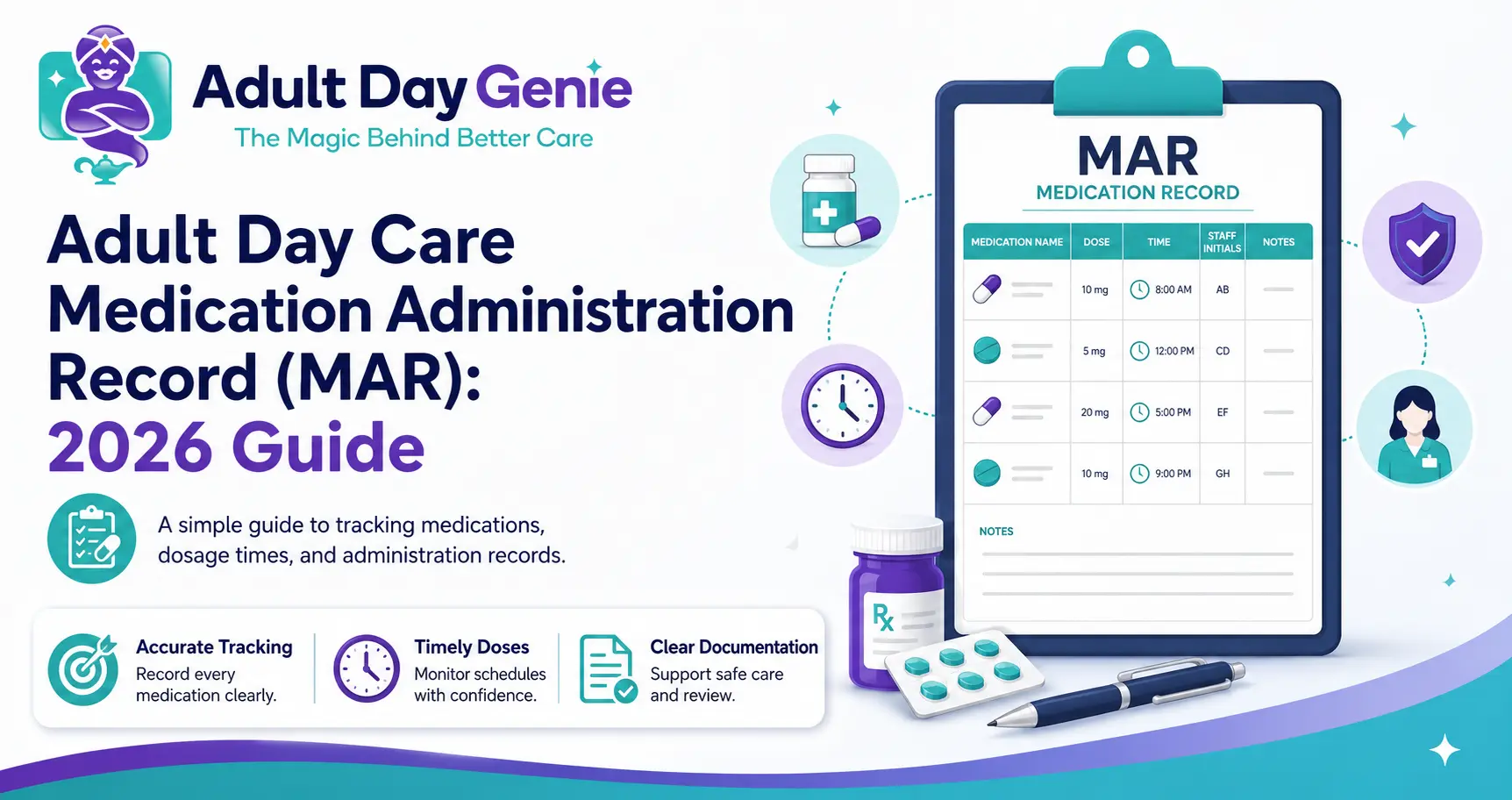
A medication administration record should help an adult day center answer a simple question later: what medication was supposed to be given, what actually happened, when was it documented, and who was responsible? A complete MAR is more than a medication list. It is part of the participant record and should make administration activity, exceptions, and follow-up understandable.
This adult day care medication administration record guide provides a practical U.S. framework for reviewing MAR completeness. It is not a universal legal form. Medication-administration rules, staff qualifications, required fields, charting timing, self-administration rules, and follow-up requirements vary by state and program.
What Is a Medication Administration Record in Adult Day Care?
A Medication Administration Record, or MAR, documents medication administration activity for a participant while the center is responsible for that medication workflow. Depending on applicable rules, it may show the medication, dose, route, scheduled time, date and time given, staff identity, and relevant omissions, refusals, errors, or reactions.
The key distinction is simple: a medication list tells staff what medications are associated with the participant; a MAR shows what happened with administration.
What Should an Adult Day Care MAR Include?
A useful adult day care MAR should make the medication order and the actual administration activity understandable without forcing staff or reviewers to interpret unexplained blanks. Use the following fields as a completeness framework, then compare them with the rules governing your center.
| MAR Field | What It Records | Why It Matters |
|---|---|---|
| Participant identification | Correct participant name and required identifiers | Helps prevent record mismatch |
| Allergies or sensitivities | Known allergies where required | Supports safer medication administration |
| Medication | Drug or product name | Identifies what is being administered |
| Strength and dose | Ordered strength and amount | Clarifies the intended dose |
| Route | Oral, topical, eye drop, or other route where applicable | Clarifies how the medication is given |
| Frequency or scheduled time | How often and when medication is due | Supports correct timing |
| Administration date and time | When the dose was actually given | Establishes chronology |
| Administration status | Given, refused, omitted, or not administered where required | Shows what actually occurred |
| Staff identity | Initials, signature, or name as required | Connects the entry to responsible staff |
| Changes or discontinuation | New, changed, or discontinued medication information where required | Helps keep the MAR current |
| Exceptions or reactions | Errors, omissions, adverse effects, or unusual reactions where required | Supports appropriate follow-up |
This table is not a substitute for a state-required adult day care medication administration record template. It is a quality-control framework for checking whether the MAR is complete and usable.
Medication List vs. MAR: What Is the Difference?
| Record | Main Purpose | Typical Focus |
|---|---|---|
| Medication list | Identifies medications associated with the participant | Current medications, dosage, prescriber, or other required details |
| MAR | Documents medication administration activity | What was given, when, by whom, and applicable exceptions |
| Medication order or label | Provides medication directions | Medication, dose, route, frequency, and instructions |
These records should agree with one another, but they are not interchangeable. A medication can appear correctly on a list while the MAR is still incomplete because the administration time, staff identity, dosage, status, or other required information is missing.
Adult Day Care Medication Administration Record Requirements Vary by State
There is no single national set of adult day care medication administration record requirements that safely applies to every center.
Pennsylvania's current medication-record rules provide one example. For covered clients who do not self-administer medication, the center must maintain a medication log identifying the medications, dosage, time, date, and the person who administered the medication. Pennsylvania also requires that information to be logged immediately after each applicable dose.
Virginia's current adult day center medication management rules identify a more detailed set of MAR elements, including participant identity, known allergies, medication indication, date prescribed, medication name, dosage and strength, route, frequency, date and time given, administering staff information, medication changes, errors or omissions, and adverse reactions.
Those examples show why a national MAR guide should separate common completeness fields from legally required fields. Your final form and workflow should be mapped to the licensing, Medicaid, payer, and program requirements that actually govern your center.
When Should Medication Administration Be Charted?
Charting should follow the timing required by the rules governing your program and your center's approved policies. Do not automatically use another state's timing standard.
Pennsylvania provides a clear example: its required medication-log information must be entered immediately after each client's dose. Virginia separately requires medication administered by center staff to be given within the applicable scheduled-time window and requires the MAR to document the date and time given.
The practical documentation principle is straightforward: record medication activity close enough to the event that the MAR reflects what actually happened rather than requiring staff to reconstruct the medication pass later from memory.
How Should Refused, Missed, or Not-Given Doses Be Documented?
An unexplained blank is difficult to interpret. It could mean a medication was not due, was refused, was unavailable, was intentionally not administered, was omitted, or simply was never documented.
The adult day care medication log should therefore use the status or exception method required by the governing rules and center policy. Montana's current adult day care medication rule, for example, requires the MAR to address medications administered as well as medications that were refused or not administered.
- Which medication and scheduled dose were affected
- Whether the medication was refused or not administered
- When the exception occurred
- Who documented the event
- Whether notification was required
- Whether additional follow-up was required
- Where any related documentation can be found
The exact notation method, notification requirements, and follow-up process should come from your applicable rules and center policy rather than a generic national template.
Who Can Administer Medication in an Adult Day Center?
Staff qualification requirements vary by jurisdiction and adult day service model. A national article should not assign one professional license, certification, or training requirement to every center.
Pennsylvania and Virginia, for example, both specify who may administer medications in covered adult day programs, but the requirements are not identical. Centers should verify applicable professional-license, medication-aide, training, supervision, and refresher requirements.
For broader workforce qualifications, ratios, roles, and staff records, use Adult Day Genie's adult day care staffing requirements guide rather than turning the MAR article into a staffing guide.
What a 2026 Adult Day Center Deficiency Shows About MAR Documentation
A MAR does not have to be completely missing to create a documentation problem. A form can exist and still be incomplete.
In a Pennsylvania Department of Aging inspection completed on February 19, 2026, an adult day center was cited because Medication Administration Record forms for two clients did not contain complete medication directions. For one client, several entries contained the medication name but were missing dosage and full instructions. Another medication entry did not contain the complete instructions reflected on the pharmacy label.
The same inspection also cited Pennsylvania's requirement that the applicable medication information be logged immediately after each dose.
The operational lesson is useful beyond one state: do not review a MAR only for whether a medication name appears. A stronger review compares the MAR with the applicable medication order or label and checks that required directions, dosage information, administration details, and staff documentation are complete.
Common Adult Day Care Medication Documentation Errors
- Medication name entered but dose or strength missing
- Directions incomplete compared with the current order or pharmacy label
- Missing administration date or time
- Blank administration status with no explanation
- Missing staff initials, signature, or identity where required
- Refused or not-given dose not clearly documented
- Changed or discontinued medication remaining active on the MAR
- Medication list and MAR no longer matching
- Documentation entered later from memory
- Medication error or adverse-reaction follow-up not documented where required
- Using another state's form without checking local requirements
A useful quality-control question is: Can an appropriate reviewer tell what was ordered, what actually happened, who documented it, and whether any exception still needs follow-up?
Paper MAR vs. Electronic MAR
| Format | Potential Advantage | Important Limitation |
|---|---|---|
| Paper MAR | Familiar and simple to start | Missing fields, handwriting, corrections, and retrieval may require more manual review |
| Electronic MAR or eMAR | Structured fields and searchable history can improve visibility | Still must be configured and used according to applicable rules |
| Either format | Can document the medication workflow | The format alone does not determine compliance |
Electronic records can make missing information easier to identify and records easier to retrieve, but technology does not make an incorrect process compliant by itself. Centers still need current orders, qualified staff, appropriate policies, accurate entries, and required follow-up.
MAR Review Checklist Before a Survey or Record Request
- Confirm the MAR belongs to the correct participant and reporting period.
- Compare active medications with the current order, label, and medication list.
- Check medication name, dose or strength, route, frequency, and scheduled time where required.
- Review each administration field for a clear status.
- Confirm required staff initials, signatures, or identifying information are present.
- Check refusals, omissions, errors, and reactions for required documentation and follow-up.
- Confirm medication changes and discontinuations are reflected.
- Look for unexplained blanks, conflicting entries, or unclear corrections.
- Verify that the form and workflow match current state and program requirements.
For a broader review of participant, service, billing, and operational records, use Adult Day Genie's adult day care audit checklist rather than expanding this MAR guide into a complete audit-preparation article.
Keep Medication Records Connected to the Participant Record
Medication documentation does not exist in isolation. Depending on the participant and applicable requirements, medication-related information may connect with health information, the current assessment, the care plan, service-day documentation, and incident follow-up.
For the wider recordkeeping framework, Adult Day Genie's adult day care documentation requirements guide explains where medication records fit alongside assessments, care plans, attendance, service notes, incidents, and billing-supporting documentation.
When a medication-related need affects the participant's planned services or supports, the center may also need to determine whether the individualized plan should be reviewed under applicable requirements. Adult Day Genie's adult day care care plan template covers that care-planning workflow separately.
Adult Day Genie connects participant records, care plans, forms, attendance, day-of-service documentation, reports, and other operational records in one workflow. Explore Adult Day Genie software features if your center is trying to reduce the number of paper files, spreadsheets, and disconnected records staff must reconcile.
Final Takeaway
A complete adult day care medication administration record should make the medication, administration activity, staff responsibility, and required exceptions understandable without forcing a reviewer to guess what a blank or incomplete field means.
A strong MAR process reconciles the current order or label with the record, charts medication activity according to applicable timing rules, documents exceptions clearly, and reviews the record before small gaps become larger documentation problems.
If your center is managing participant forms, care plans, attendance, daily documentation, and review-ready records across separate systems, bring your current workflow to a 15-minute Adult Day Genie walkthrough and see how the wider participant record can stay connected.
Frequently Asked Questions
What does MAR mean in adult day care?
MAR means Medication Administration Record. It documents medication administration activity for a participant, including required medication details, administration information, staff identity, and applicable exceptions according to the rules governing the center.
What information should a medication administration record include?
Common MAR fields include participant identity, medication name, dose or strength, route, frequency or scheduled time, administration date and time, staff identity, and applicable omissions, errors, refusals, changes, or reactions. Exact required fields vary by jurisdiction and program.
When should medication administration be documented?
Follow the rules governing your center. Pennsylvania, for example, requires its specified medication-log information to be recorded immediately after each applicable dose. Other jurisdictions may use different requirements.
Is a medication list the same as a MAR?
No. A medication list identifies medications associated with the participant. A MAR documents medication administration activity, including when medication was given and who administered or documented it as required.
How should a refused medication be documented?
Use the refusal or exception method required by the center's governing rules and policies rather than leaving the MAR field unexplained. Any required notification or follow-up should also be documented.
Can adult day centers use an electronic MAR?
Electronic MARs may be used when they satisfy the requirements and policies applicable to the center. Electronic software can help structure and retrieve records, but using an electronic system does not by itself guarantee compliance.