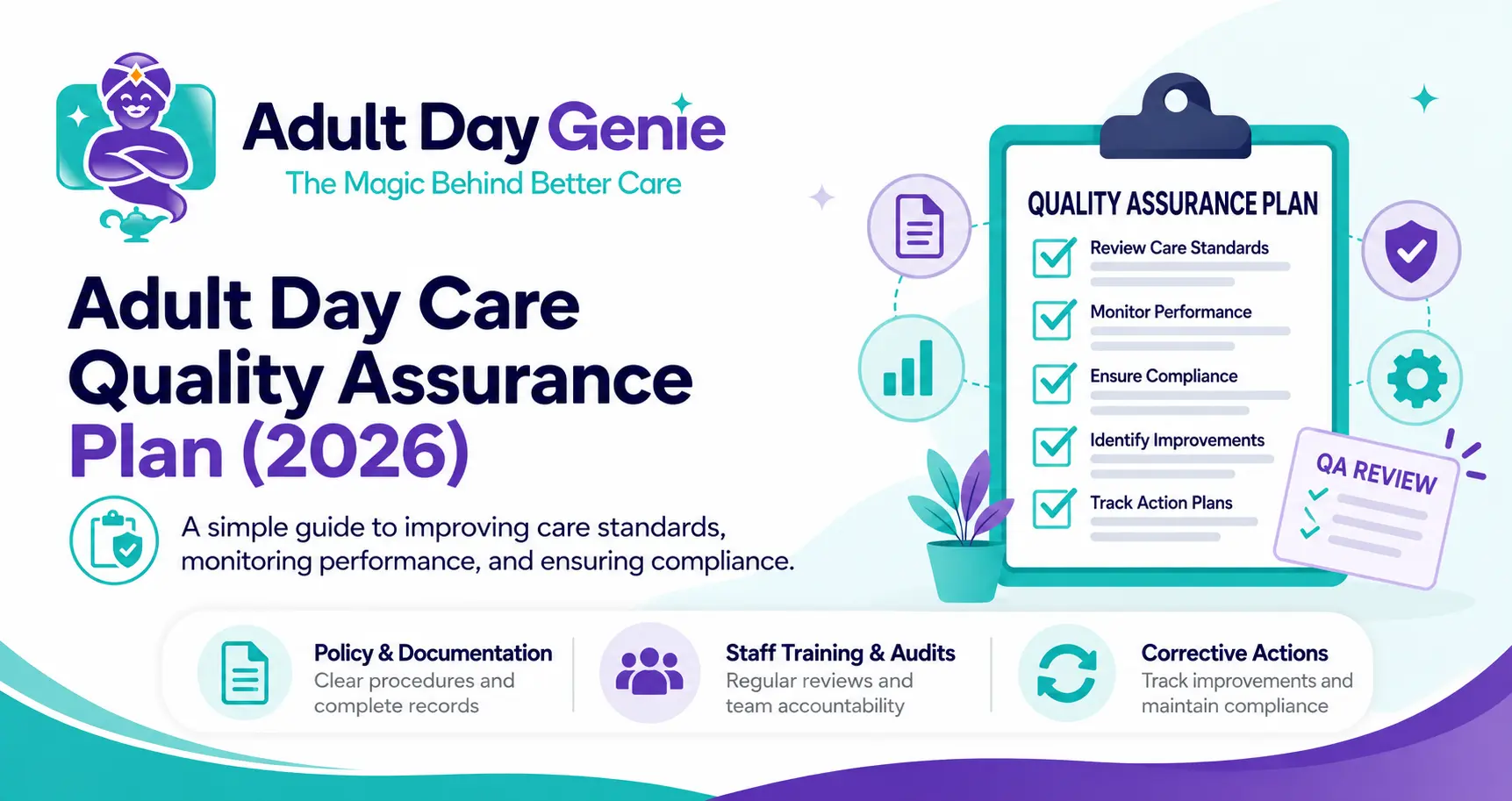
An adult day care quality assurance plan turns everyday records into a repeatable process for improving services. Instead of waiting for an inspection, serious incident, complaint, or documentation problem, the center routinely reviews evidence, identifies gaps, assigns corrective actions, and checks whether those changes actually worked.
For adult day operators, that evidence can come from attendance, participant records, care plans, incidents, medication documentation, complaints, satisfaction feedback, staff training, and other operational records. The goal is not to create another binder that sits on a shelf. A useful QA/QI process connects what the center measures with what management changes.
Requirements vary by state, program type, licensing authority, Medicaid program, and payer. Use this guide as an operational framework, then verify the specific quality-assurance requirements that apply to your center.
What Should an Adult Day Care Quality Assurance Plan Include?
An adult day care quality assurance plan should identify what the center wants to improve, how performance will be measured, who will review the information, what happens when a problem is found, who owns the corrective action, when follow-up will occur, and what evidence will show whether the change worked.
- Defined quality priorities
- Measurable objectives
- Assigned responsibility
- Data sources
- Review frequency
- Incident and complaint review
- Participant or family feedback
- Care-plan or record audits
- Corrective actions
- Follow-up measurement
- Written findings
- Improvement goals and implementation steps
The exact requirements should always be checked against the rules governing the individual center.
Quality Assurance vs. Quality Improvement: What Is the Difference?
Quality assurance and quality improvement are closely related, but they are not exactly the same. Quality assurance identifies whether expected standards are being met, while quality improvement uses those findings to change processes and improve future results.
| Concept | Main Question | Practical Purpose |
|---|---|---|
| Quality assurance (QA) | Are we meeting the expected standard? | Identify gaps, errors, risks, or inconsistent processes |
| Quality improvement (QI) | How can we make the process better? | Change the process and measure whether performance improves |
| Corrective action | What are we going to do about the identified problem? | Assign a specific response, owner, deadline, and follow-up |
A center might use QA to discover that care-plan reviews are being completed late. QI begins when management investigates why, changes the workflow, assigns responsibility, and measures again to determine whether timeliness improved. In that sense, a strong adult day care quality improvement plan should be a closed loop rather than a one-time inspection exercise.
Do Adult Day Centers Need a Quality Improvement Plan?
Requirements are not identical across the United States, so centers should not assume one national rule applies everywhere. Washington's adult day center quality assurance requirements require an annual quality improvement plan that identifies quality concerns, actions to address them, and specific measurable objectives. The rules also identify program evaluations, utilization reviews, satisfaction surveys, and care-plan sampling as possible quality-assurance activities.
Georgia likewise requires adult day centers to develop and implement an annual quality improvement plan. Its evaluation framework includes serious incidents and corrective actions, satisfaction results and complaints, program changes, improvement goals, and an implementation plan under the state's adult day center rules.
Those are useful examples, but they should not be treated as universal national requirements. Each center should verify its own state's current licensing, Medicaid, contractual, and program rules.
The Adult Day Care QA/QI Cycle
A practical adult day center quality assurance plan can be organized around one repeatable improvement cycle: Measure → Identify → Investigate → Correct → Assign → Re-measure → Document.
1. Measure
Collect reliable information about what is actually happening. Examples can include attendance, incidents, complaints, participant feedback, record completeness, care-plan reviews, medication events, staff training, or billing and documentation exceptions.
2. Identify
Look for a gap, trend, recurring issue, or area where performance does not meet the center's goal or an applicable requirement.
3. Investigate
Ask why the issue occurred. Avoid jumping directly from a problem to staff retraining without understanding the cause. The real issue may be unclear responsibility, a poor form, an unrealistic workflow, inadequate staffing at a particular time, or a process that depends too heavily on memory.
4. Correct
Choose a specific action that addresses the identified cause rather than using a vague response such as asking staff to be more careful.
5. Assign
Name the person responsible for completing the corrective action and establish a clear due date.
6. Re-measure
Review the same evidence after the change so management can determine whether the action actually improved the process.
7. Document
Record what was found, what changed, who was responsible, when follow-up occurred, and whether the follow-up showed improvement.
Adult Day Care Quality Assurance Checklist
A practical adult day care quality assurance checklist should help management move from broad quality goals to a repeatable review process.
- Define the quality or compliance areas being reviewed
- Set measurable goals or objectives
- Identify the records or data that will be reviewed
- Assign responsibility for the QA/QI process
- Set a review frequency appropriate to the issue
- Review incidents, complaints, and participant feedback
- Audit selected participant records or care plans
- Document corrective actions
- Assign an owner and due date to each action
- Recheck the issue after the corrective action
- Measure whether the change worked
- Retain QA/QI findings and follow-up documentation
When choosing detailed performance measures, use the adult day care KPIs guide for the measurement layer rather than rebuilding the entire KPI strategy inside this article.
What Data Should an Adult Day Center Review?
QA/QI works best when decisions are based on consistent operational evidence rather than memory. The goal is not to track every possible number, but to review information that helps management identify meaningful risks, service gaps, and improvement opportunities.
| Data Source | What It Can Help Reveal |
|---|---|
| Attendance records | Absence patterns, utilization issues, and inconsistent recording |
| Incident reports | Repeated safety events or operational risks |
| Assessments | Changes in participant needs or gaps between assessed needs and services |
| Care plans | Late reviews, incomplete goals, or inconsistent updates |
| Medication records | Missing documentation, refusals, or recurring medication issues |
| Complaints and grievances | Repeated participant or family concerns |
| Satisfaction feedback | Experience trends and service opportunities |
| Staff training records | Missing or overdue education |
| Documentation reviews | Missing, late, or inconsistent records |
| Billing exceptions | Operational gaps that may affect claim readiness |
For deeper recordkeeping guidance, review the adult day care documentation requirements guide rather than duplicating those requirements inside the QA/QI plan.
Build an Adult Day Care Corrective Action Plan
Finding a problem is only the first half of QA/QI. An adult day care corrective action plan should make the response specific enough that another manager can understand what is changing, who owns the change, when it must be completed, and how success will be evaluated.
| Corrective Action Field | What to Record |
|---|---|
| Issue | The problem that was identified |
| Evidence | Records or findings supporting the concern |
| Root cause | Why the issue appears to be occurring |
| Corrective action | What the center will change |
| Owner | Person responsible for completing the action |
| Due date | When the action should be completed |
| Success measure | How the center will judge improvement |
| Follow-up date | When the issue will be reviewed again |
| Result | What the follow-up showed |
Avoid corrective actions such as "staff will be more careful." A stronger corrective action identifies what will actually change—for example, assigning a responsible role, revising a form, changing a workflow, adding a review step, or providing targeted training.
Example: From an Incident Trend to Corrective Action
Consider a hypothetical example. A center notices several falls or near-falls during the morning arrival period. Management reviews the adult day care incident report records and identifies where and when the events occurred.
| QA/QI Step | Example |
|---|---|
| Signal | Incident reviews show repeated events around morning arrival |
| Review | Management examines incident records and timing |
| Investigation | Staff coverage is inconsistent during transportation-to-building transitions |
| Corrective action | Assign a specific staff role to the arrival zone and revise the arrival procedure |
| Owner | Program director |
| Follow-up | Review incident records again after the workflow change |
| Evidence | Revised procedure, staff communication or training record, incident trend report, and follow-up findings |
The purpose is not simply to prove that management responded. The center should determine whether the response actually improved the process.
Include Participant and Family Feedback
Quality cannot be measured only through internal records. Participant, caregiver, and family feedback may identify service problems that routine documentation does not reveal.
- Participant satisfaction surveys
- Caregiver or family surveys
- Complaints and grievances
- Participant comments
- Suggestions
- Reasons for discharge
- Recurring communication concerns
Washington specifically lists participant and former-participant satisfaction surveys among possible quality-assurance tools, while Georgia's quality-improvement framework includes satisfaction results, comments, and complaints. Feedback should lead somewhere: a repeated concern should be reviewed, assigned, acted on where appropriate, and checked again.
Audit Care Plans and Participant Records
Record review is another valuable quality-assurance method. The Maryland Adult Day Care Quality Assurance Manual includes care-plan review, health-record audits, participant-needs review, satisfaction feedback, and other QA tools.
A center does not necessarily need to review every record every time. A structured sample can help identify recurring problems.
- Current assessments
- Current care plans
- Required signatures
- Timely reviews
- Consistent service documentation
- Medication records where applicable
- Follow-up after significant changes
Use the adult day care assessment checklist and adult day care care plan template when a quality review identifies gaps in those specific workflows. After corrective action is completed, repeat the review so the center can determine whether the improvement held.
How Often Should the QA/QI Plan Be Reviewed?
There is no single national review frequency that should be applied to every adult day program. Some states explicitly require annual quality plans or evaluations, while higher-risk operational issues may need much more frequent review.
- High-risk incidents may require immediate review
- Complaints may need review when received
- Documentation samples may be reviewed monthly or quarterly
- Satisfaction information may be analyzed periodically
- Formal program evaluation may occur annually where required
The center's schedule should reflect applicable requirements and the seriousness of the issue being monitored.
What QA/QI Records Should the Center Keep?
A defensible quality-improvement process should leave a clear record of what management reviewed, what it decided to change, who owned the change, and what happened during follow-up.
- QA/QI meeting notes
- Data or reports reviewed
- Audit findings
- Incident trend summaries
- Survey summaries
- Complaint reviews
- Corrective action plans
- Assigned owners and deadlines
- Staff training resulting from findings
- Revised policies or procedures
- Follow-up measurements
- Re-audit results
- Annual evaluation or improvement reports
These records can also make it easier to demonstrate that quality management is an active operational process rather than a policy that exists only on paper. For a broader review-readiness perspective, use the adult day care audit checklist alongside the QA/QI process.
How Software Can Support Adult Day Care Quality Improvement
Software does not create a quality program on its own. It can, however, make the underlying evidence easier to retrieve, organize, and review.
Adult Day Genie keeps operational information such as attendance, care plans and forms, medication records, reports, exports, and correction history connected to the participant record. That can make it easier to move from questions such as "Do we think this happened?" to "What does the record show?"
A useful quality-management system still requires leadership to choose what to measure, review findings, determine corrective actions, assign responsibility, and evaluate whether changes worked. The software supports the evidence behind that process.
Adult Day Care Quality Assurance FAQs
What is an adult day care quality assurance plan?
An adult day care quality assurance plan is a structured process for reviewing program performance, identifying quality or compliance concerns, documenting corrective actions, and measuring whether changes improve services. Exact required elements vary by state and program.
What is the difference between quality assurance and quality improvement?
Quality assurance checks whether the center is meeting expected standards. Quality improvement uses QA findings to change processes and improve future results. A complete QA/QI process uses both.
What should an adult day care quality assurance plan include?
A plan should generally define quality goals, measurable objectives, responsible staff, data sources, review frequency, incident and feedback review, record audits, corrective actions, follow-up measures, and written documentation of results.
How often should an adult day care QA/QI plan be reviewed?
The required frequency depends on the jurisdiction and program. Some states require annual quality improvement plans or evaluations, while higher-risk issues may need more frequent operational review.
What should an adult day care corrective action plan include?
A corrective action plan should document the problem, supporting evidence, likely cause, action to be taken, responsible owner, completion date, success measure, follow-up date, and final result.
Does every adult day center have the same quality-assurance requirements?
No. Licensing standards, Medicaid rules, payer contracts, and program requirements vary by jurisdiction and service model. Centers should verify the rules that apply to their specific program.
Turn Quality Reviews Into Measurable Improvement
An adult day care quality assurance plan should do more than identify problems. It should create a repeatable path from evidence to action: Measure → Identify → Investigate → Correct → Assign → Re-measure → Document.
When attendance, participant documentation, care plans, medication records, corrections, and reports are spread across disconnected systems, quality review becomes harder than it needs to be. Adult Day Genie can show you how the daily records behind your QA/QI process stay connected in one adult-day-specific platform. See Adult Day Genie plans and book a walkthrough.