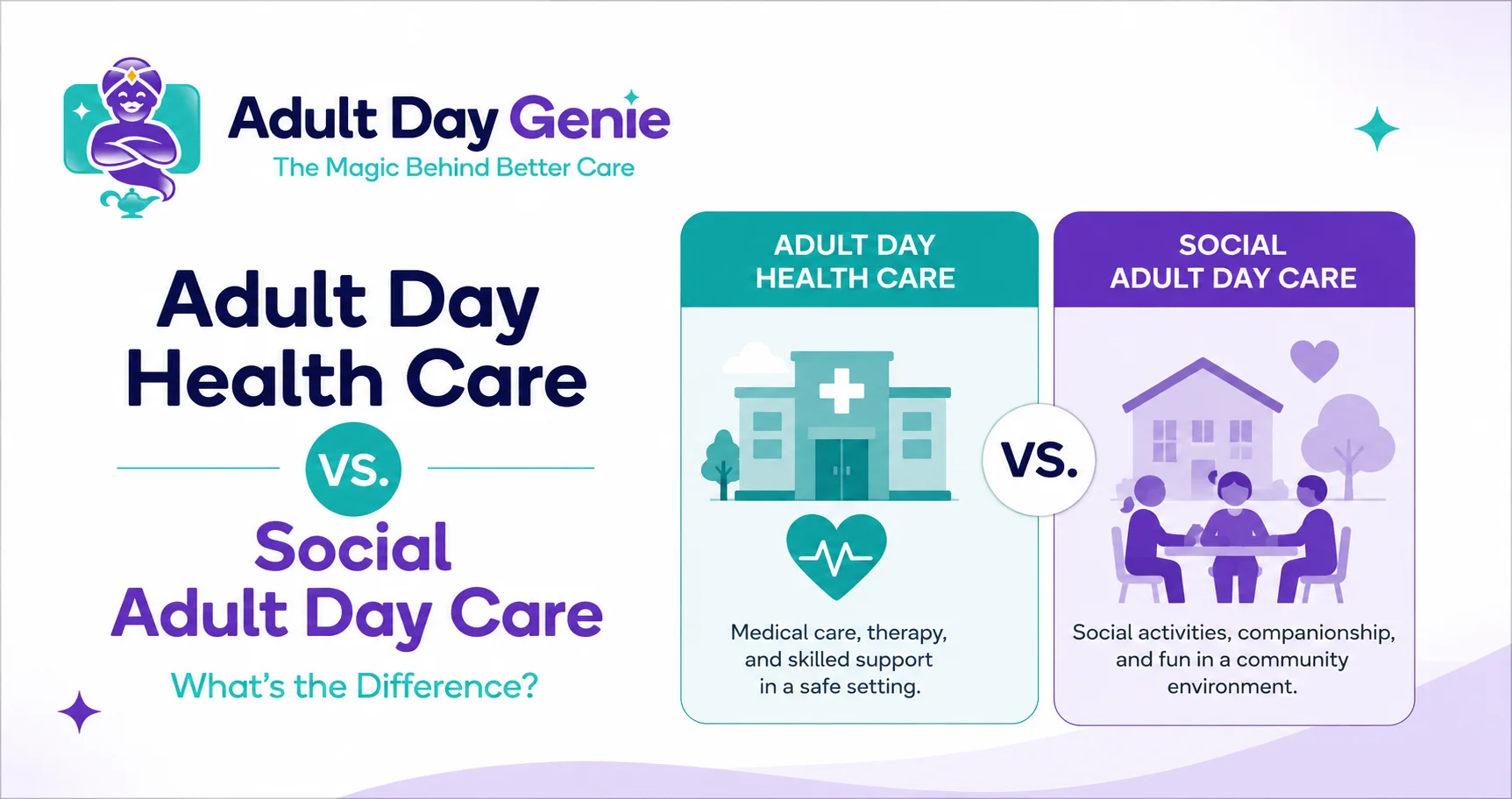
Adult day health care and social adult day care may operate under the same broad adult day services umbrella, but they are not always the same type of program. The main difference between adult day health care and social adult day care is the level of health and clinical services provided. Social programs generally emphasize supervision, structured activities, meals, socialization, and supportive assistance. Adult day health programs add a medical or clinical layer that may include nursing, health monitoring, medication-related services, rehabilitation, or other skilled care.
Quick answer: Social adult day care primarily supports supervision, socialization, meals, activities, and daily assistance. Adult day health care generally serves participants who also need organized health or clinical services. Exact definitions, staffing rules, licensing requirements, and reimbursement methods vary by state.
This guide provides general operational information, not legal, licensing, or reimbursement advice. Always verify the definitions and requirements that apply in your state and program.
Adult Day Health Care vs. Social Adult Day Care: Quick Comparison
The easiest way to understand adult day health care vs social adult day care is to compare the purpose of each model, the needs of the participants it typically serves, and the level of clinical support built into the program.
| Area | Social Adult Day Care | Adult Day Health Care |
|---|---|---|
| Primary focus | Supervision, socialization, activities, and supportive care | Health services plus social and supportive care |
| Typical participant | Needs structure, supervision, activities, or routine assistance | Has health or functional needs requiring clinical oversight |
| Nursing | Usually not the defining service | Commonly part of the program model |
| Health monitoring | Limited or program-specific | Often included |
| Medication services | Depends on state and program rules | More likely to include clinical medication support |
| Therapy or rehabilitation | Usually limited or provided externally | May include physical, occupational, speech, or other rehabilitation |
| Staffing | Primarily direct-care and social-program staff | May require nurses and other licensed professionals |
| Documentation | Attendance, care plans, activities, meals, and service records | May include additional nursing and clinical documentation |
| Licensing | State-specific | May involve additional health-related requirements |
| Payment | Private pay or public programs depending on state | May involve Medicaid or other health-related reimbursement arrangements |
This table is a general comparison, not a national licensing definition. States use different names and regulatory structures for adult day services.
What Is Social Adult Day Care?
Social adult day care, sometimes called social adult day services, is generally designed for adults who need a safe and structured setting during the day but do not require the level of ongoing clinical care associated with an adult day health program.
- Supervision and monitoring
- Social and recreational activities
- Meals and snacks
- Assistance with activities of daily living
- Caregiver respite
- Transportation where offered
- Case coordination or supportive services
- Structured programs that support independence
A social program can still serve people with chronic conditions, mobility limitations, cognitive impairment, medications, dietary needs, and detailed care plans. The distinction is that skilled clinical services generally are not the defining feature of the social model.
What Is Adult Day Health Care?
Adult day health care adds organized health services to the social and supportive functions of an adult day program. Depending on the jurisdiction and program, services can include nursing assessment or oversight, health monitoring, medication-related services, rehabilitation, health education, personal care, and interdisciplinary care planning.
- Nursing assessment or oversight
- Health monitoring
- Medication administration or management where permitted
- Skilled nursing services
- Physical, occupational, or speech therapy
- Rehabilitation services
- Health education
- Personal care
- Clinical or interdisciplinary care planning
Federal research on adult day services has found that, in states distinguishing the two models, skilled nursing and other health services are commonly part of the dividing line between social and health-oriented programs. HHS adult day services guidance provides broader context on these models.
Social Model vs. Medical Model Adult Day Care
You will often see the same comparison described as social model vs medical model adult day care. In general, the social model refers to social adult day care, while the medical model refers to adult day health care.
However, the terminology is not standardized nationally. Some states regulate separate social and health models, some allow combined approaches, and some use the term adult day care for programs that provide more health services than the phrase social model might suggest. The HHS regulatory review of adult day services documents this state-to-state variation.
For operators comparing social adult day care vs medical adult day care, the actual state definition and permitted scope of services matter more than the marketing name used by the center.
How Do Participant Needs Differ?
The better question is not which model is better. It is which model can safely and appropriately meet the participant's assessed needs.
- Social adult day care may fit participants who primarily need supervision, structure, activities, meals, companionship, or routine assistance
- Adult day health care may fit participants who also require nursing oversight, clinical monitoring, skilled services, or rehabilitation within the program's licensed scope
Participant needs can also change over time. Someone appropriately served in a social program may later develop health or functional needs that exceed what the program is licensed or staffed to provide.
How Do Staffing Requirements Differ?
Staffing is one of the biggest operational differences between social and medical models. Social programs still need qualified personnel and must follow applicable adult day care staffing requirements, including state-specific ratios, training, supervisory roles, and personnel documentation.
Adult day health programs may have additional clinical staffing requirements because their licensed scope includes health services. Depending on the state and program, that can mean nurses, therapists, social-service professionals, or other licensed personnel.
The staffing model should follow the licensed scope of the program. Hiring a nurse does not automatically convert a social program into an adult day health program, and a health program cannot ignore clinical staffing requirements simply because few participants need nursing on a particular day.
How Do Documentation Requirements Differ?
Both models need reliable records. Social adult day programs may maintain attendance, participant profiles, care plans, activity records, meals, incidents, transportation information, authorizations, and other service documentation.
Adult day health care often adds a deeper clinical documentation layer. Depending on the program, that can include nursing notes, health assessments, clinical plans of care, medication records, rehabilitation documentation, physician-related information, and other payer- or state-required health records.
Regardless of the model, accurate adult day care attendance tracking remains part of the operational foundation. A center should be able to show who was actually present and connect that service day with the documentation required for the program.
How Do Licensing and Regulations Differ?
There is no single national licensing structure for adult day services. States differ in the terminology they use, the agencies responsible for oversight, the services each program may provide, and whether social and health models are licensed separately.
- Identify the state definition that applies to your program
- Determine which adult day service model you plan to operate
- Review the services the license permits or requires
- Verify staffing and professional requirements
- Review documentation and care-plan obligations
- Confirm payer and reimbursement rules before billing
The business model should follow the regulatory structure rather than choosing a label first and trying to make the requirements fit afterward.
How Do Medicaid and Billing Differ?
Payment rules can differ substantially between social adult day care and adult day health care. Medicaid coverage depends on the state, waiver, managed care structure, service definition, authorization requirements, and provider qualifications.
New York provides a useful example. Current New York adult day billing guidance distinguishes adult day health care from social adult day care using separate HCPCS service codes. That state-specific example should not be treated as a nationwide billing rule.
Operators should identify the service model first, then verify authorization, documentation, units, codes, and reimbursement rules for that specific program.
Can One Center Provide Both Models?
In some jurisdictions, yes. Some states permit combined models or allow organizations to operate more than one adult day service type. Others regulate the programs separately.
Sharing a location does not necessarily eliminate separate licensing, staffing, documentation, service-plan, or billing requirements. Operators considering both models should verify whether the state permits them to coexist and what records or staff assignments must remain distinct.
How Adult Day Genie Fits Both Program Types
Adult Day Genie is built for center-based adult day care and adult day health programs that need a clearer daily operational record. The software does not determine whether a center should be licensed as a social model or medical model.
Instead, Adult Day Genie helps connect attendance, participant information, care plans and forms, meals and activities, authorizations, family updates, reporting, and Medicaid claim preparation. Those records matter in either service model because operators still need to answer the same basic questions: who was present, what services were required, what happened during the day, and where is the supporting documentation?
For centers replacing disconnected spreadsheets and paper files, connected adult day care software can make that daily record easier to maintain and review.
Frequently Asked Questions
What is the main difference between adult day care and adult day health care?
Adult day care generally focuses on supervision, activities, meals, socialization, and supportive assistance. Adult day health care adds clinical services such as nursing, health monitoring, medication-related services, or rehabilitation, depending on state requirements.
Is social adult day care the same as adult day care?
Often, but not universally. Social adult day care usually refers to the non-medical or social model, but states use different terminology and regulatory definitions.
Is adult day health care the medical model of adult day care?
Adult day health care is commonly described as the medical model because it includes organized health or clinical services in addition to social and supportive services.
Does adult day health care require nurses?
Many adult day health programs require nursing or other licensed clinical involvement, but exact staffing requirements depend on the state, license, and program.
Can social adult day care bill Medicaid?
In some states and programs, yes. Medicaid coverage depends on the applicable service definition, waiver or managed care arrangement, authorization requirements, and payer rules.
The difference between adult day health care and social adult day care affects more than the program description. It can change which participants the center can serve, which professionals must be available, what documentation is required, which agency regulates the program, and how services are reimbursed. Start with your state's actual definition and licensed scope, then build staffing, documentation, attendance, care planning, and billing around that model. Adult Day Genie supports center-based adult day care and adult day health programs by keeping the service day's operational records connected. See Adult Day Genie in 15 minutes to see how your program's workflow can fit into one clearer daily record.